








Index
- What Is Customer-Centric or Customer Centricity?
- Customer-Centric and Customer Success: How to Build Long-Term Relationships
- How to Implement a Customer-Centric Strategy Step by Step
- Tools for Creating a Customer-Centric Approach
- How to Put the Customer-Centric Approach into Practice with Tecalis

The best content in your inbox
Companies that focus their energy solely on perfecting their product are losing the real battle in the marketplace: the user experience. Today, sustained success depends directly on how you make life easier for your customers. This shift toward a customer-centric model transforms the organization from the ground up, requiring that every operational decision stem from an understanding of the user in order to deliver real and immediate value.
Building a customer-centric strategy goes far beyond offering good technical support. It requires a robust culture driven by data, empathy, and technology to ensure customer success. In this article, we break down this methodology, its impact on the bottom line, and the steps to implement it using digital tools that eliminate friction and boost customer loyalty.
Discover which tools industry leaders use for a customer-centric strategy
Request a consultation with our expertsWhat Is Customer-Centric or Customer Centricity?
Customer-Centric (or Customer Centricity) is the business strategy that places the customer at the very core of all the organization’s operational, design, and financial decisions, rather than focusing solely on the product. Its goal is for the entire organization—from marketing to support—to design every action to solve real user problems and maximize the long-term value the customer receives.
Unlike traditional models focused solely on the product, this methodology requires that every new service, sales process, or technological tool be implemented by answering a single question: How does this improve the experience and solve our users’ problems? Adopting a truly customer-centric culture involves completely transforming the corporate mindset, shifting from simply selling to connecting with the consumer.
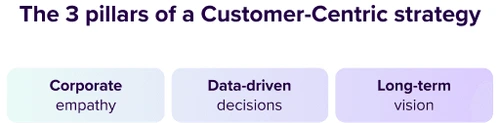
And this isn’t just a whim: according to Qualtrics’ 2026 Customer Experience Trends Report, 92% of consumers say that good service brings them more satisfaction than good value for money—proof that the focus can no longer be solely on the product. For this transition to ensure seamless, frictionless, and highly profitable interactions for the brand, the model must be built on three fundamental pillars:
- Corporate empathy: Deeply understanding the user’s challenges.
- Data-driven decisions: Using real feedback and consumer behavior—not assumptions—to guide strategy.
- Long-term vision: Prioritizing customer lifetime value over closing a one-time sale or seeking only immediate profit.
While the traditional model creates a product and then seeks buyers, the customer-centric approach reverses the equation. It first analyzes the user’s needs and pain points and, from there, designs tailored solutions.
Benefits of Adopting a Customer-Centric Strategy
Implementing a customer-centric strategy requires a cross-functional effort involving every department in the company, from Human Resources to Sales and IT Development. However, the return on investment (ROI) from this effort is monumental: a 2026 study by the Association for the Development of the Customer Experience (DEC) confirms that organizations that prioritize the customer experience increase their revenue up to 10% faster than those that compete solely on price or product. Below, we detail the main benefits organizations gain by adopting this culture:
- Sustained loyalty and retention: Making life easier for the customer eliminates friction. A customer who perceives continuous value and efficient service rarely turns to the competition, which extends their relationship with the brand and multiplies the total revenue they generate over the years. According to the Genesys “State of Customer Experience” report (2026), 85% of consumers admit to having reduced their spending or abandoned a brand altogether after a bad experience—a cost that a customer-centric culture helps prevent at the root.
- Direct increase in profitability: Satisfied customers buy more and more frequently. Having in-depth knowledge of your audience’s history and behavior allows you to execute cross-selling and up-selling strategies naturally, raising the average purchase amount.
- Assertive, risk-free, and customer-oriented innovation: A customer-centric culture establishes channels for continuous feedback. This means that the company’s innovation is directly guided by what customers are clamoring for. The risk of failure in new product launches is reduced because these products are already validated by the market’s real needs.
- Dramatic reduction in operating costs: By anticipating problems or pain points and improving the experience from the very first point of contact, incidents, returns, and the workload on technical support teams are drastically minimized.
- Unshakable brand reputation: Exceptional experiences transform ordinary buyers into true brand ambassadors, generating word-of-mouth marketing that cannot be bought through advertising.
- Agile, data-driven decision-making: A customer-centric strategy is constantly grounded in the analysis of actual user behavior. By making decisions based on objective information rather than assumptions or instincts, the company can react quickly and adapt its course in response to any market changes or new trends.
- Attracting and Retaining Talent: Companies that lead in customer experience project a strong and ethical corporate image. Top professionals prefer to build their careers in organizations that are respected and valued by society.
Customer-Centric and Customer Success: How to Build Long-Term Relationships
Building strong business relationships requires understanding that Customer Centricity and Customer Success are two sides of the same coin. While customer centricity is the overarching philosophy and cross-functional culture that guides decisions throughout the company (that is, the “why” and “how” we think), customer success is the proactive, methodological area specifically responsible for ensuring that users achieve their goals when using your product or service.
| Aspect | Customer-Centric | Customer Success |
|---|---|---|
| What It Is | A culture and philosophy that encompasses the entire company. | A specific operational area or team. |
| Scope | Cross-functional: product, marketing, sales, support, finance. | Primarily the post-sale customer lifecycle. |
| Main objective | To ensure that every decision the company makes adds real value for the customer. | To ensure the customer achieves their goals with the product or service. |
| Typical metrics | NPS, CSAT, Customer Lifetime Value (CLV) | Renewal rate, adoption rate, upselling rate, churn rate. |
| Responsibility | The entire organization, led by management | The Customer Success team or Account Managers |
| Time Horizon | Long-term strategy and vision | Proactive and ongoing day-to-day management |
To build truly lasting relationships, the rule is clear: the Customer Success department will only be effective if the entire company shares a user-centric mindset. These professionals need agile digital tools, processes free of red tape, and full executive support to eliminate any friction. This way, they can guide the user throughout their entire learning curve, ensuring rapid adoption that minimizes initial doubts and frustration.
In practice, this synergy ensures that the customer doesn’t just make a simple purchase, but fully realizes the potential of your solution. When the organizational philosophy streamlines day-to-day operations and the Customer Success team takes a proactive approach by delivering real value, an environment of unwavering loyalty is created. Together, they ensure that the customer succeeds, renews their contracts naturally, and grows alongside your brand for years to come.
It’s useless for your Customer Success team to help users get the most out of your software if the platform then has glitches or billing is a bureaucratic mess. Without a comprehensive customer-centric culture that eliminates these friction points, the team’s efforts will be in vain, and the customer will eventually leave.
Discover how other companies have transformed their customer experience
Check out Tecalis’ success storiesHow to Implement a Customer-Centric Strategy Step by Step
Moving from theory to practice and transforming the entire organizational structure requires a precise roadmap. To build a truly customer-centric strategy and ensure it’s adopted at every level of the company, you must follow these five fundamental steps:
1.Get to know the customer and map the customer journey: Before taking action, research is essential. You must map every touchpoint the user has with the brand—from the moment they discover the service through the post-sale phase—to identify exactly where friction occurs and resolve it at its source.
- Personalize every experience to the fullest: Personalization is the key differentiator. Using the data collected allows you to offer unique experiences, from adapting to the user’s preferred communication channels to tailoring recommendations based on their history. Hyper-personalization demonstrates that the company views the customer as a unique individual and not just an account number.
- Train and align the entire team: The strategy will fail if only the sales or support department believes in it. Fostering a customer-centric culture means training employees, from software engineers to sales representatives. Everyone must understand how their daily work impacts the final customer experience.
- Establish a feedback loop: Decisions cannot be based on intuition. Implementing agile surveys, measuring metrics, and actively listening ensures that product evolution is guided solely by real market demands.
- Implement technology that eliminates bureaucratic barriers: The human factor is crucial, but at scale, it’s impossible to sustain a customer-centric approach without the right technology. It’s essential to have tools that eliminate operational friction. A good CRM to centralize data is essential. However, to take innovation a step further, platforms are needed that make interactions as seamless as possible at critical moments, such as identity verification during onboarding and the electronic signing of contracts.
Implementing this profound internal transition doesn’t happen overnight, but the resulting profitability more than justifies the effort. By integrating these five pillars, the organization will not only create an environment where the user feels like the protagonist but will also optimize operational resources by avoiding time spent on inefficient processes. The key to long-term success lies in maintaining an agile mindset, where corporate empathy and cutting-edge technology come together to evolve at the same pace as market demands.
Tools for Creating a Customer-Centric Approach
To implement a customer-centric approach, it is vital to address the processes where the greatest administrative friction typically occurs. Providing seamless digital solutions during the verification and onboarding stages is not merely a competitive advantage but a structural necessity to ensure the user’s success from their very first interaction with the company.
Digital Onboarding Systems and KYC Processes
The registration of a new user—or digital onboarding—represents the customer’s first operational impression. Requiring physical or manual procedures undermines the experience and drives up dropout rates. To address this, the integration of digitized KYC (Know Your Customer) systems allows for identity verification in seconds using artificial intelligence and biometrics, ensuring the following competitive advantages:
- Instant and automated verification: Real-time validation of identity documents and facial recognition, without the need for manual intervention or in-person visits.
- Drastic reduction in drop-off rates: Complete elimination of initial technical barriers, significantly increasing the conversion rate during account opening.
- Maximum regulatory compliance: Guaranteed fraud prevention and adherence to the strictest international regulations, executed in a manner that is completely transparent to the end user.

Signature: Simple, Instant Onboarding
Forcing a customer to print a lengthy document, sign it by hand, scan it, and send it back is the antithesis of a customer-centric strategy. The electronic signature stands as the ultimate tool for achieving seamless onboarding, eliminating weeks-long closing cycles and reducing them to mere minutes, while ensuring that the business agreement is finalized without bureaucratic hurdles.
In addition to providing an unparalleled user experience, an advanced electronic signature ensures full legal validity in any corporate environment. The customer receives a secure link, reviews the contract optimized for their device’s screen, and signs it using a biometric signature or a one-time password (OTP). This approach combines the strictest legal security—backed by qualified trusted service providers (QTSPs)—with a 100% digital, convenient, and paperless contracting process.
How to Put the Customer-Centric Approach into Practice with Tecalis
Adopting a truly customer-centric culture on a global scale requires technology partners who understand that regulatory rigor and security must not compromise agility. In this context, Tecalis positions itself as the definitive strategic partner for organizations seeking to place the user at the center of all their operations.
Putting this approach into practice requires integrating modular, scalable solutions specifically designed to eliminate any administrative hurdles. Adopting Tecalis’ technology enables organizations to bring this strategy to life and ensure customer success through the following key capabilities:
- Advanced Digital Onboarding New user registration is managed through Tecalis Identity, which implements automated KYC processes to verify identity in a matter of seconds—securely and 100% remotely—eliminating barriers to entry.
- Instant and Secure Contract Signing Business deals are transformed with Tecalis Sign, which allows agreements to be formalized in real time, from any device, with full international legal validity.
- Seamless user experience The entire journey is streamlined thanks to Tecalis Customer Hub, which integrates identity verification, contract signing, and omnichannel sales management, ensuring that every interaction is fast, intuitive, and geared toward long-term customer loyalty.
Ultimately, combining a user-focused organizational culture with Tecalis’ technology brings the true customer-centric model to life. Offering 100% digital, fast, and secure interactions is now the essential standard for leading the market, building customer loyalty, and ensuring sustained business growth.
Frequently Asked Questions (FAQs)
- What Is “Customer-Centric”? It is a business management strategy that places the customer at the center of all organizational decisions—including product, operational, and financial decisions—rather than focusing solely on the product. Its goal is for every process, from marketing to support, to respond to the user’s real needs.
- What is the difference between a customer-centric approach and customer success? A customer-centric approach is the company’s overall culture and philosophy; customer success is the operational area that proactively ensures the customer achieves their goals with the product or service. The latter only works well if the entire organization embraces the former.
- What are the pillars of a customer-centric strategy? It rests on three pillars: corporate empathy to understand the user, decision-making based on real data, and a long-term vision focused on the value of the customer lifecycle rather than a one-time sale.
- What role does technology play in a customer-centric culture? It is the element that enables empathy to scale: a CRM centralizes customer data, and digital onboarding and electronic signature solutions eliminate friction at critical moments such as sign-up or contract signing—two of the points where the most customers are lost.
- How long does it take to implement a customer-centric strategy? There’s no one-size-fits-all timeline: it depends on the organization’s size and its existing digital maturity. However, adopting tools like digital onboarding or electronic signatures can reduce processes that previously took weeks to just minutes, accelerating visible results from the very first months.
Learn how our solutions transform your customer-centric strategy
Put the customer at the center of your business