











Index
- What is it and what is it for?
- Legal validity of handwritten signatures: uses, limitations, and digitized signatures
- Handwritten signature vs. digital signature: key differences
- How to digitize your handwritten signature and use it in online documents
- Conclusion: Handwritten signatures in the digital age
'/%3e%3cpath%20d='M13.6641%205.76325L30.0315%2018.448M50.9456%205.30859L31.8502%2019.8575L30.0315%2018.448M13.6641%2031.6784L30.0315%2018.448'%20stroke='white'%20stroke-width='2'%20stroke-linecap='round'%20stroke-linejoin='round'/%3e%3cpath%20d='M34.5781%2017.582L50.9456%2031.2216'%20stroke='white'%20stroke-width='2'%20stroke-linecap='round'%20stroke-linejoin='round'/%3e%3cdefs%3e%3clinearGradient%20id='paint0_linear_137488_197253'%20x1='12.75'%20y1='5.60216'%20x2='38.5997'%20y2='41.6392'%20gradientUnits='userSpaceOnUse'%3e%3cstop%20offset='0.161458'%20stop-color='%23FF8066'/%3e%3cstop%20offset='1'%20stop-color='%237756DB'/%3e%3c/linearGradient%3e%3c/defs%3e%3c/svg%3e)
The best content in your inbox
In a world where most procedures are carried out online, handwritten signatures remain a key legal element. Although it may seem like an obvious concept, its definition, legal validity, and relationship with digital signatures often raise questions.
This article provides a clear and up-to-date explanation of what a handwritten signature is, when it is valid, how it differs from a digital signature, and what happens when a signature on paper is digitized.
Convert your handwritten signature into a legally valid digital signature
Discover how to maintain the security and traceability of your documentsWhat is it and what is it for?
A handwritten signature is the unique and personal mark that a person draws on a physical document to express their will, consent, or authorship.
It is made with ink on paper (or other physical medium) and usually includes a combination of letters, symbols, or strokes characteristic of the signer. Its main purpose is to identify the author of the document and demonstrate their binding intention regarding its content. From a legal and forensic perspective, it serves three essential functions:
- Identification: it allows the person signing to be recognized.
- Authentication: it demonstrates that the signer has read and accepts the terms of the document.
- Non-repudiation: it prevents the signer from subsequently denying having performed the act.
Legally, a handwritten signature is valid evidence in court proceedings, administrative procedures, and civil contracts, provided that:
- It has been made with conscious intent.
- The medium is stable and legible.
- There are no subsequent unauthorized alterations.
In the European Union, the eIDAS Regulation (No. 910/2014) does not invalidate handwritten signatures, but establishes a parallel framework for electronic signatures. By default, if a regulation does not explicitly require a qualified electronic signature, the handwritten signature remains fully valid (Article 25.1 eIDAS).
Types of handwritten signatures and when they are used
There are three main types of handwritten signatures: full name signature (most secure), initials (abbreviated), and sign or mark (for people who cannot write). Their validity depends on the legal context and the consensus between the parties:
- Signature with full name: This is the most formal and secure method. Includes first and last names. Recommended for high-value contracts, notarial acts, and complex legal documents.
- Initials: This is an abbreviated or stylized signature, often consisting of initials, strokes, or personalized symbols. It is commonly used in official correspondence or repetitive documents, but its legal validity depends on the context and prior agreement between the parties.
- Signature with a sign or mark: Used when a person cannot write, they can use a cross, fingerprint, or any other identifiable sign. In these cases, it must be accompanied by the presence of witnesses or a competent authority, according to the legislation of each country.
The traditional handwritten signature has critical limitations: it is not immediate, it can be forged, it is difficult to verify without expert analysis, and its physical medium is fragile because it can deteriorate, be lost, or be damaged.
These limitations have driven the development of digital alternatives, but they have also raised new questions about their digitization and legal validity.
Differences between handwritten signatures and digital handwritten signatures
The main differences between the two methods lie in the nature of the medium used and the technical security guarantees that each can offer. While one relies on traditional graphology, the other relies on technological infrastructures to ensure legal validity in the digital environment.
Handwritten signature
- It is made by hand on paper.
- Its authenticity is verified by experts.
- Does not guarantee the integrity of the document.
- Does not allow remote signing.
Handwritten digital signature
- It is done on digital documents.
- It uses digital certificates and cryptographic techniques.
- It allows identity and integrity to be verified automatically.
- Suitable for remote signing.
- Complies with regulations such as eIDAS.
The handwritten digital signature, when designed correctly, integrates:
- Real-time biometric capture via touchscreens or tablets.
- Advanced electronic seal linked to a digital certificate.
- Cryptographic hash to guarantee document integrity.
- Legal metadata such as timestamp, IP, geolocation, and digital fingerprint.
Inserting a scanned image of a signature into a PDF does not constitute a valid handwritten digital signature, but rather a simple visual representation with no binding legal value. This error is very common and can have serious legal consequences.
Legal validity of handwritten signatures: uses, limitations, and digitized signatures
Handwritten signatures are legally valid in almost all legal systems, including Spanish, European, Latin American, and North American law. However, a scanned copy of a handwritten signature does not replace the physical original and does not have full legal validity in procedures that require an original signature.
Requirements for a handwritten signature to be legally valid (according to Spanish law and eIDAS):
For a signature to be fully legally effective, it is essential that the process complies with a series of conditions that guarantee its authenticity. These are:
- Manifest will of the signer: they must have consciously wanted to sign.
- Clear identification: it must be possible to unequivocally associate it with a person.
- Stable medium: the document must be recoverable and legible over time.
- Document integrity: there must be no alterations after signing without consent.
If a scanned copy is submitted, the original must be available upon request.
When is a digitized handwritten signature valid?
This is where the most delicate nuance comes in. A document signed by hand and then scanned retains its legal validity provided that:
- The original physical version is retained and can be presented if required.
- The digital copy is not intended to be used as a legal substitute for the physical original.
- In contexts where the law requires an original handwritten signature (e.g., holographic wills, certain notarial procedures, or acts of incorporation), a scanned copy is not sufficient.
On the other hand, if an electronic signature platform captures the handwritten stroke in real time and links it cryptographically to the document, then it is considered an advanced electronic signature with full legal validity, in accordance with the eIDAS Regulation.
How is the authenticity of a handwritten signature verified?
Its authenticity is verified by forensic handwriting analysis to determine whether the signature was made by the person who claims to have made it. The most common forensic verification methods are:
- Morphological analysis: shape, height, slant, strokes, and nature of the letters.
- Dynamic analysis: pressure, speed, and rhythm to detect whether the signature was made naturally or imitated.
- Comparison with authentic signatures: multiple samples are analyzed to identify consistent patterns.
- Analytical support: microscopy, ultraviolet light, ink analysis.
This process is costly, slow, and subjective in some respects. For this reason, advanced electronic signatures (including handwritten digital signatures with biometrics) offer immediate, objective, and secure verification through cryptographic protocols. This eliminates the need for expert analysis.
Handwritten signature vs. digital signature: key differences
With the advancement of technology and the digitization of procedures, the use of digital signatures (or electronic signatures) has emerged strongly as an alternative to handwritten signatures. The differences between the two are not merely formal: they affect security, legality, practicality, and usefulness in modern contexts.
| Criterion | Handwritten signature | Digital signature |
| Support | Physical paper | Digital document |
| Authentication | Visual/Expert | Cryptographic + digital certificate |
| Verification | Slow, costly, subjective | Immediate, automatic, objective |
| Security | Low (easy to forge) | High (impossible to replicate without private key) |
| Legal validity | General, except for legal exceptions | Full, according to eIDAS |
| Remote use | No | Yes |
| Document integrity | Not guaranteed | Guaranteed by hash |
When to use each one?
The choice between traditional and digital formats depends on both the specific legal context and the speed required for the transaction. Identifying the appropriate scenario allows you to optimize processing times while maintaining maximum legal certainty.
- Handwritten signature: in notarial acts, holographic wills, documents where the law requires a physical signature, or when there is no access to technology.
- Advanced digital signature: in commercial, labor, financial, or administrative contracts, or any procedure that allows electronic means (which, in practice, is the vast majority in the EU and many Latin American countries).

How to digitize your handwritten signature and use it in online documents
To digitize your handwritten signature with full legal validity, you must use an advanced electronic signature platform that captures your stroke geometrically and links it cryptographically to the document. Inserting a scanned image is not legally valid. The correct way to digitize it is simple:
- Capture the actual stroke with a tablet or touch screen.
- Record biometric data (pressure, speed, rhythm).
- The signature must be cryptographically linked to the document.
- An electronic seal and timestamp must be issued.
- The resulting document must be verifiable and unalterable.
The step-by-step process is as follows:
The step-by-step process is as follows:
- Access a certified platform such as Tecalis Sign.
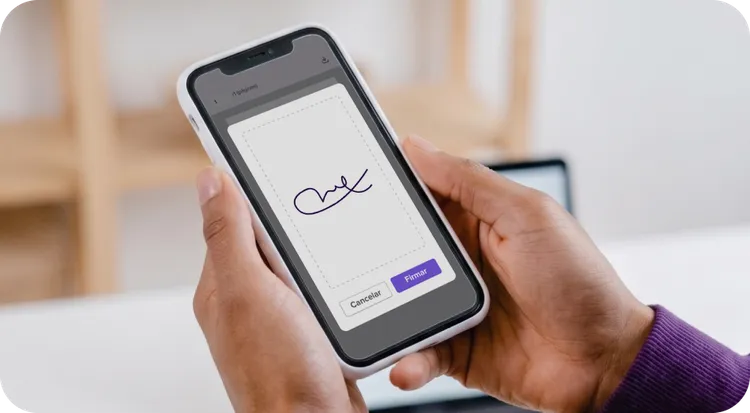
- Select the handwritten signature option using a pen or your finger.
- Sign on the screen as you would on paper.
- The platform automatically generates an advanced electronic signature in accordance with eIDAS. It does this using biometric capture (pressure, speed), an electronic seal, and a hash of the document or evidence record (timestamp, IP, geolocation).
- The document is sealed, unalterable, verifiable at all times, and legally valid.
This method is not simply "inserting an image," but transforming your stroke into an electronic signature with full legal validity.
Do you want to sign documents online with security, eIDAS certification, and complete traceability?
Get started with Tecalis SignHow it is implemented in practice with Tecalis Sign
Tecalis Sign is a platform that allows handwritten signatures (one of its main signature types) with full legal validity through biometric capture and qualified certificates, without the user needing to have a prior digital certificate.
Unlike solutions that only insert images, Tecalis has the following key features:
- It uses biometric technology to capture the stroke.
- It uses qualified certificates to generate an advanced electronic signature.
- It allows real-time verification of the authenticity of the signer and the integrity of the document.
- It provides a probative record with a timestamp, location, IP address, and digital fingerprint of the document.
Its unique advantage is that it transforms handwritten strokes into an electronic signature with a higher legal status than a scanned signature, without any technical complexity for the end user.
Use cases for handwritten signatures in current environments
Although most procedures allow digital signatures, handwritten signatures are still mandatory and preferred in specific contexts such as holographic wills, notarial deeds, or international procedures with apostilles. Cases where handwritten signatures are required include:
- Holographic wills: in Spain and many other countries, these must be written and signed entirely by hand by the testator.
- Notarial deeds: although they are being digitized, many still require a physical signature before a notary.
- Paper lease agreements: in certain jurisdictions, if the parties choose physical media.
- Documents for foreigners: in international procedures, a handwritten signature with legalization or apostille is sometimes required.
However, in 90% of administrative and commercial procedures, it is already possible to use advanced electronic signatures, including handwritten digital signatures with biometrics.
Cases where a digital (scanned) handwritten signature is not valid
It is essential to distinguish between a robust electronic signature and a simple digitized image, as the latter lacks the technical evidence necessary to protect against challenges. In certain highly sensitive legal acts, the law requires higher guarantees that a scanned signature cannot provide. These cases are:
- Notarial contracts.
- Company incorporation deeds.
- Tax returns requiring a certified signature.
- Wills (except in specific formats authorized by law).
Conclusion: Handwritten signatures in the digital age
Handwritten signatures are still legally valid, but their digitization requires eIDAS-compliant technology. Scanning an image is not enough. The real solution is to use advanced electronic signature platforms that biometrically capture the stroke and cryptographically seal it. This guarantees legal validity, security, traceability, and efficiency, complying with the eIDAS Regulation, the GDPR, and national regulations. To sign online with your handwritten stroke and full legal validity, choose solutions such as Tecalis Sign and not PDF editors that insert images.
Looking to create a legally valid handwritten signature online? Make sure the platform:
- Captures your stroke in real time.
- Generates an advanced electronic signature.
- Provides an unalterable evidential record.
Otherwise, your signature will have no legal value and you could incur legal risks or have the document declared null and void.
Frequently asked questions (FAQs)
- Is a handwritten signature scanned into a PDF legally valid? No. A scanned image has no legal validity; only the original physical document signed by hand is fully valid.
- Can I use my handwritten signature in legally valid online procedures? Yes, but only if it is captured in real time with an advanced electronic signature platform (such as Tecalis Sign), not if it is inserted as an image.
- What is the difference between an initialed signature and a signature with a full name? A signature with your full name clearly identifies the signer and is more secure; an initialed signature (abbreviated or symbolic) has limited validity and requires prior agreement.
- Will handwritten signatures still be necessary in the future? Yes, in specific cases such as holographic wills or notarial deeds, although their general use will decline with digitization.
- How is the authenticity of a handwritten signature verified? Through forensic handwriting analysis. This is a slow and costly process, unlike the automatic verification of advanced electronic signatures.
Discover our guide to the different types of electronic signatures and which one is best for you
Download it for free