





Index
- What Is the Anti-Fraud Law and Who Does It Affect?
- Key Requirements for Compliance with Anti-Fraud Regulations
- Processes and Tools for the Anti-Fraud Law
- Effective Date and Considerations
- Penalties and Risks: What to Consider If You Don’t Update Your Systems
- Software and Best Tools for Complying with the Anti-Fraud Law and Selling Safely

The best content in your inbox
The digital transformation of businesses is no longer just a matter of competitiveness—it has become a strict legal requirement. With the goal of eradicating the underground economy and ensuring complete transparency in commercial transactions, the new Anti-Fraud Law promoted by the Tax Agency has permanently changed the rules of the game for invoicing and accounting in Spain. Specifically, the Anti-Fraud Law in Spain is already in effect, and its technical implementation—the Verifactu regulation—will be mandatory for users by the end of 2027.
Ignoring this new regulatory framework is not an option if you want to avoid hefty fines and protect your business’s reputation. Below, we break down all the key points of this law, the critical deadlines you need to keep on your radar, and how technology—from certified software to identity verification and electronic signatures—will be your greatest ally in securing your sales with complete confidence.
What Is the Anti-Fraud Law and Who Does It Affect?
The Anti-Fraud Law (enacted in Spain under Law 11/2021) establishes a regulatory framework designed to combat tax evasion and the underground economy. Its primary technological objective is the eradication of so-called “dual-use software”—that is, accounting and invoicing software that allows users to maintain parallel sets of books, alter records, or conceal sales.
This regulation affects the entire business sector across the board, regardless of a company’s revenue. Compliance is mandatory for:
- Self-employed individuals and independent professionals: Who must ensure that the software they use to issue invoices complies with the Tax Agency’s standards.
- SMEs (Small and Medium-Sized Enterprises): Which often use ERP or invoicing systems that must now be certified and protected against tampering.
- Large corporations and software developers: Who bear direct responsibility for creating, marketing, or using systems that guarantee absolute transparency of tax information.
Key Requirements for Compliance with Anti-Fraud Regulations
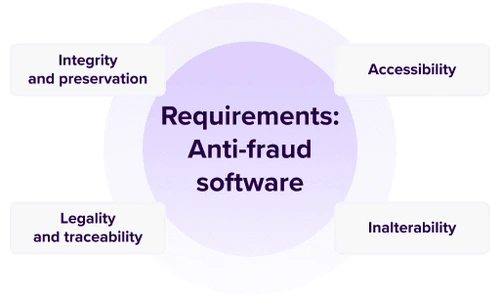
For management and invoicing software to be fully compliant under the new Anti-Fraud Law framework, a simple cosmetic update is not enough. The system must technically guarantee that tax and accounting information cannot be tampered with, strictly adhering to the following non-negotiable principles:
- Integrity: Recorded data cannot be altered or corrupted under any circumstances, ensuring that the original information remains accurate.
- Retention: The software must have automatic mechanisms that guarantee the secure storage and preservation of data for the legally stipulated periods.
- Accessibility: The Tax Agency must be able to access the records immediately, easily, and without technological barriers in the event of an audit.
- Legibility: The formats in which data is stored must be standardized and easily understandable, avoiding encryption that prevents official review.
- Traceability: Each accounting entry or invoice must be traceable to its origin, with detailed records of who, when, how, and where each transaction was generated.
- Immutability: Once data is recorded, the system must block any attempt to modify it retroactively. If there is a justified change, there must be a permanent, auditable trail of that alteration.
Complying with all these requirements means definitively moving away from tools such as traditional spreadsheets or basic software that allows manual edits. The starting point, however, is far from ideal: according to the Quipu 2025 Barometer, 95% of small consulting firms and SMEs still use Excel as their primary tool, and 65% of Spanish SMEs were not prepared to comply with the regulations before the most recent extension**. The transition to certified technological solutions is the only valid path to operating within the law.**
According to the law (and its implementation in the VeriFactu regulations), the responsibility for complying with the law does not rest solely with the invoicing company but also with the software manufacturer. It is crucial that you require your technology provider to provide a written affidavit certifying that their software fully complies with these six requirements mandated by the tax authorities.
Processes and Tools for the Anti-Fraud Law
Adapting to this new legal framework requires going far beyond simply updating the invoicing software. Companies must audit and secure every phase of interaction with their customers from the very first contact. Below, we analyze the critical stages of the user lifecycle and the essential technological tools needed to safeguard business operations under the highest standards of security and transparency.
Identity Verification and Prevention (AML and KYC)
Comprehensive identity verification serves as the first line of defense against any attempt at corporate fraud. Before formalizing a contract, issuing an invoice, or initiating a business relationship, it is essential to reliably verify who is on the other side of the screen. Without this initial certainty, the entire subsequent traceability process loses its validity.
To address this challenge, digital onboarding platforms integrate automated KYC and AML controls. Using advanced technologies such as facial biometrics, document recognition via OCR, and real-time cross-checking against international sanctions lists, these tools verify a user’s authenticity in seconds. This neutralizes the risk of identity theft from the moment of registration and ensures regulatory compliance required of regulated entities (banks, insurance companies, real estate firms)—a factor that is absolutely critical for safeguarding the operations of any business.
Comprehensive Traceability and Transaction Logging
Once identity has been verified, it is vital to document every action taken by the customer. Comprehensive traceability compiles the user’s digital and documentary footprint, automatically capturing the following elements to comply with the Anti-Fraud Law:
- The exact moment the user registers and accepts the legal terms.
- Every commercial milestone in the process, from the creation of the quote to the final invoice.
- Key metadata (IP address, device, and timestamp) that irrefutably prove who performed the action and when.
Appropriate software acts as a continuous digital notary throughout this process. This monitoring prevents any attempt at manipulation or accidental deletion, strictly complying with the Tax Agency’s traceability requirements.
Immutability and Document Protection (Electronic Signature)
The final link in ensuring compliance with the Anti-Fraud Law and protecting business operations is guaranteeing that the generated documentation—whether contracts, quotes, agreements, or pro forma invoices—cannot be modified once the parties have given their approval. In this scenario, the electronic signature (in its advanced or qualified forms) plays a central role as the cornerstone of regulatory and operational compliance.
Unlike a simple digital mark, these tools use cryptographic certificates that uniquely and non-transferably link the signer’s identity to the document. If the file undergoes even the slightest alteration after signing, the certificate is automatically invalidated, revealing the tampering. Added to this is the timestamp, issued by a Certification Authority, which certifies the exact second of the signature and demonstrates the document’s integrity in the face of any tax audit. For this protection to be effective in day-to-day operations, it must be based on three key pillars:
- Undisputable legal validity: The advanced or qualified electronic signature offers legal guarantees equivalent to or greater than those of a traditional handwritten signature, constituting robust evidence in any court of law.
- Agile and automated integration: The solution must connect directly via APIs to the business management system, allowing signature requests to be initiated without interrupting employees’ workflow.
- Frictionless user experience: The end customer must be able to sign from their own cell phone in a matter of seconds, using accessible and secure methods such as one-time passwords via SMS or biometric validation.
Implementing this level of document security ensures strict compliance with the law and prevents hefty fines, all while accelerating the closing of sales and providing a seamless user experience.
Discover how to bring your accounting systems into compliance with current regulations and avoid penalties
Free consultation for your businessEffective Date and Considerations
The official timeline for the entry into force of the Anti-Fraud Law and its technical regulations has been modified to facilitate technological adaptation, but the final deadlines have now been set. In fact, it has been postponed twice: first by Royal Decree 254/2025 (to 2026) and then by Royal Decree-Law 15/2025, published in the Official State Gazette (BOE) on December 3, 2025, which moved the date to 2027. While software developers and vendors are required to adapt their programs and issue affidavits of compliance as of July 29, 2025, the deadline for end users is 2027. Specifically, companies and corporations must use certified invoicing systems starting January 1, 2027, while self-employed individuals and independent professionals will have until July 1 of that same year to comply.
Given these deadlines, businesses that will be particularly affected—such as those with a high volume of cash transactions or B2B businesses that have until now used spreadsheets for their invoicing—should begin their transition as soon as possible. The procedure involves auditing the current system and requiring the IT provider to provide a certificate of compliance with tax regulations. If your current software lacks this certification or you’re still operating with manual processes, now is the time to migrate to a comprehensive technological solution that safeguards your operations from the very start.
Getting a head start on the 2027 deadlines is key to avoiding implementation issues. Auditing your systems in advance and requiring the Verifactu declaration of compliance from your IT providers will ensure a smooth transition, free from operational issues and the risk of penalties.
Penalties and Risks: What to Consider If You Don’t Update Your Systems
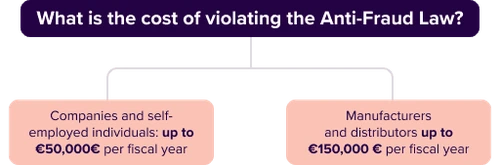
Operating with obsolete systems or maintaining manual invoicing processes poses a massive legal and financial risk to your business. The regulations establish a very severe penalty system specifically designed to deter the manufacture, sale, and use of uncertified accounting software or software that allows even the slightest manipulation of data. The Anti-Fraud Law provides for a very severe penalty system to deter the use of uncertified software (Article 201 Bis of the General Tax Law):
- For end users (companies and self-employed individuals): Fines for the mere possession, installation, or use of dual-use software or programs that do not meet the required technical specifications can amount to up to 50,000 euros for each fiscal year in violation.
- For manufacturers and distributors: The law is even more stringent for technology providers, with penalties of up to 150,000 euros for each fiscal year in which they have manufactured or sold software that fails to meet the requirements for tamper-resistance.
- Concealment of Records: If an inspection reveals that accounting records have been intentionally manipulated to conceal revenue, the corresponding tax penalties for tax fraud will be added to these structural fines.
Beyond the obvious and severe economic blow, using uncertified systems directly and irreversibly damages any company’s corporate reputation. An audit that uncovers security breaches, a lack of traceability, or questionable accounting practices can completely destroy the trust of investors, strategic partners, and customers. For this reason, the proactive adoption of automated compliance technology is establishing itself as the only safe way to operate with confidence, delegating technical responsibility to specialized tools that act as a protective shield against any tax audit.
Software and Best Tools for Complying with the Anti-Fraud Law and Selling Safely
Compliance with the Anti-Fraud Law should not be viewed as a mere administrative formality, but rather as a strategic opportunity to digitize, optimize, and protect a company’s contracting and invoicing processes. The integrated use of digital onboarding tools, KYC/AML controls, and electronic signatures creates an ecosystem where every sale, contract, or invoice is recorded in an immutable manner from the very first second.
By digitizing the entire customer lifecycle with these solutions, companies not only meet the traceability and immutability requirements of current regulations but also proactively prepare their systems for the imminent arrival of mandatory electronic invoicing. This ensures that every business transaction is fully secured from the outset and 100% auditable by the Tax Agency.
This level of automation and legal protection is now the essential standard for operating with complete assurance in strategic sectors where regulatory risk is highest:
- Financial sector: To comply with anti-money laundering (AML) regulations when opening accounts or granting loans.
- Insurance sector: To verify the authenticity of the policyholder and prevent identity theft in claims.
- Real Estate: To secure earnest money agreements and lease contracts and transparently verify the source of funds.
- Telecommunications: To prevent identity theft when activating phone lines and fraud in device financing.
- B2B Services: To guarantee the integrity of complex commercial agreements, SLAs, and recurring billing.
Relying on certified technology transforms this strict legal obligation into a competitive advantage, protecting your operations against any tax audit while accelerating your sales with a seamless, frictionless digital experience.
Frequently Asked Questions (FAQs)
- Who is affected by the new Anti-Fraud Law? It affects the entire business community in Spain. Compliance is mandatory for large corporations, SMEs, self-employed individuals, and independent professionals who issue invoices, regardless of their sector or income level.
- When is it mandatory to use certified invoicing software? Software manufacturers must offer compliant solutions by July 2025. For end users, it will be mandatory in 2027: January 1 for businesses and corporations, and July 1 for self-employed individuals.
- Is the Anti-Fraud Law the same as mandatory electronic invoicing? No. The Anti-Fraud Law (VeriFactu) prohibits the manipulation of accounting records, while the Crea y Crece Law regulates the obligation to issue electronic invoices for B2B transactions. The two are distinct but complementary.
- What happens if I continue to use Excel or an uncertified program? It will no longer be legal. Fines for using or possessing non-approved programs can reach 50,000 euros for offending businesses and self-employed individuals, and up to 150,000 euros for developers.
- What is the software compliance statement? It is a mandatory legal document in which the software provider certifies in writing to its customers that the program meets all the technical requirements for data integrity and traceability mandated by the tax authorities.
Stay ahead of legal deadlines and turn this regulatory obligation into a competitive advantage
Find out how by requesting a demo