









Index
- What is mandatory electronic invoicing?
- When is electronic invoicing mandatory, and who does it affect?
- Regulations on mandatory electronic invoicing in Spain: Verifactu
- How does an electronic invoicing system work?
- Requirements for complying with the electronic invoicing obligation
- Advantages of Mandatory Electronic Invoicing Over Traditional Invoicing
- How to Adapt to Mandatory Electronic Invoicing
'/%3e%3cpath%20d='M13.6641%205.76325L30.0315%2018.448M50.9456%205.30859L31.8502%2019.8575L30.0315%2018.448M13.6641%2031.6784L30.0315%2018.448'%20stroke='white'%20stroke-width='2'%20stroke-linecap='round'%20stroke-linejoin='round'/%3e%3cpath%20d='M34.5781%2017.582L50.9456%2031.2216'%20stroke='white'%20stroke-width='2'%20stroke-linecap='round'%20stroke-linejoin='round'/%3e%3cdefs%3e%3clinearGradient%20id='paint0_linear_137488_197253'%20x1='12.75'%20y1='5.60216'%20x2='38.5997'%20y2='41.6392'%20gradientUnits='userSpaceOnUse'%3e%3cstop%20offset='0.161458'%20stop-color='%23FF8066'/%3e%3cstop%20offset='1'%20stop-color='%237756DB'/%3e%3c/linearGradient%3e%3c/defs%3e%3c/svg%3e)
The best content in your inbox
The transition to mandatory electronic invoicing represents one of the most profound fiscal, administrative, and technological changes for the business community and self-employed professionals in Spain. Far from being a simple change in format, this digitization of the invoicing process completely redefines the way companies interact with each other and with the Spanish Tax Agency (AEAT).
If you’re wondering when electronic invoicing becomes mandatory or how to implement a certified system, understanding these regulations isn’t an option—it’s an unavoidable legal requirement. In this article, we explain exactly what it is, the deadlines under the Crea y Crece Law, the requirements of the Verifactu Regulation, and how to automate this financial process in your business.
Comply with mandatory electronic invoicing standards
Free Electronic Invoicing PlatformWhat is mandatory electronic invoicing?
A mandatory electronic invoice is a tax document generated, transmitted, and stored in a structured electronic format. This document strictly complies with the legal requirements applicable to traditional invoices, ensuring its authenticity and integrity through electronic signatures. For tax authorities, the concept is based on three technical pillars:
- Structured format: Unlike a PDF (which is unstructured), these files allow for automatic processing by accounting systems and the Spanish Tax Agency (AEAT).
- Advanced electronic signature: A cryptographic mechanism that ensures the issuer is who they claim to be and that the content has not been altered.
- Interoperability: The ability of different invoicing software systems to "understand" each other using standard languages.
Difference between an electronic invoice and a scanned paper invoice
It is essential not to confuse visual digitization with actual electronic invoicing. Unlike a scanned PDF invoice that requires manual intervention, a true structured invoice (such as XML or FacturaE) contains data that can be processed automatically, making it the only fully valid and mandatory format under the new B2B regulations.
The implementation of this electronic invoicing system pursues three key objectives at the national and European levels. First, it aims to combat late payments by ensuring the traceability of commercial payments to protect the liquidity of SMEs. Second, it promotes tax transparency and fraud prevention by preventing the alteration or destruction of invoices already issued, thereby eliminating "dual-use software." Finally, it promotes administrative efficiency by eliminating paper costs and automating data entry into accounting systems.
When is electronic invoicing mandatory, and who does it affect?
Mandatory implementation depends directly on the invoice recipient (public or private sector) and the issuer’s turnover, and is phased in as follows:
Mandatory for companies invoicing the public sector
In Spain, electronic invoicing in the B2G (Business-to-Government) environment is established by Law 25/2013. It has been mandatory since 2015, and any company or self-employed individual working with public administrations must comply with these essential requirements, starting with issuing the invoice in a structured format known as FacturaE.
Additionally, the document must be transmitted using the General Entry Point for Electronic Invoices (FACe) as the submission platform. Regarding the financial threshold, this procedure is mandatory for amounts exceeding 5,000 euros, although it should be noted that many local governments require it from the very first cent.
Mandatory electronic invoicing in the private sector
The major change concerns transactions between companies and self-employed individuals. According to the Crea y Crece Law, the timeline stipulates that companies with an annual turnover exceeding 8 million euros will be required to issue and receive electronic invoices one year after the regulatory implementation of the law is definitively approved.
Meanwhile, other companies and self-employed individuals with annual revenue of less than 8 million euros will have a two-year grace period following the approval of the regulation.
The requirement for B2B electronic invoicing will be implemented in phases. While large companies will have only one year to adapt following the regulation’s approval, SMEs and self-employed individuals will have two years to implement their systems.
Regulations on mandatory electronic invoicing in Spain: Verifactu
The electronic invoicing requirement is based on two parallel regulatory pillars that demand simultaneous compliance: the Crea y Crece Law (Law 18/2022), which regulates B2B exchange by requiring certified platforms and the reporting of status updates, and the Verifactu Regulation (Royal Decree 1007/2023), which stems from the Anti-Fraud Law. The latter prohibits software that allows for parallel accounting, promotes the direct submission of records to the AEAT, and establishes that generating a simple PDF is no longer legally valid.
To comply with current regulations, all invoicing software must meet the following technical and legal specifications:
- SILAIF Requirements: Under the Verifactu regulations, all invoicing software must meet the requirements of Security, Integrity, Legibility, Accessibility, Interoperability, and Non-alterability.
- Data Integrity: For the system to be considered legally valid, it must ensure that the information has not been modified after issuance.
- Mandatory retention: The software or associated system must ensure that invoices are stored for a minimum period of 4 years.
- Legibility: The software must allow the issuer, the recipient, and the Spanish Tax Agency (AEAT) to access the content without ambiguity.
- Chained hash generation: Technically, the software must create a chained hash code for each invoice to prevent tampering with the history.
- Use of electronic signature: The system must incorporate an electronic signature to authenticate the records.
- Inclusion of a QR code: It is mandatory to print a QR code on all graphical representations (PDFs or paper) of invoices.
Generating a simple PDF is no longer legally valid. To comply with Verifactu, the software must guarantee the immutability of the data through a chained hash and verify the issuer’s identity with an electronic signature, preventing any subsequent modifications.
How does an electronic invoicing system work?
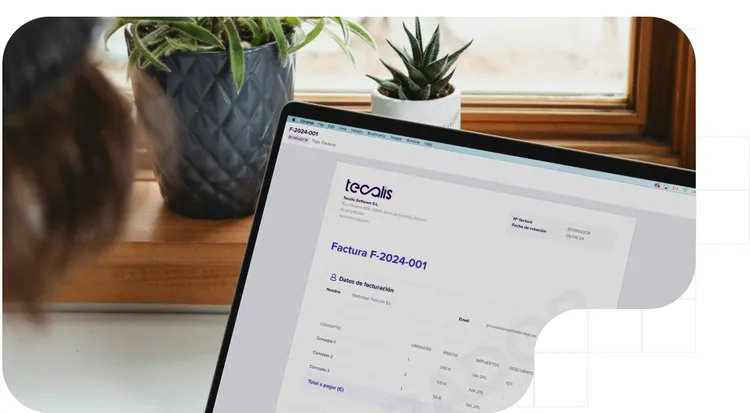
For the end user, the process eliminates paperwork, email attachments, and manual data entry, simplifying the sales cycle through a standard workflow where the document is generated exactly as usual. The software handles the necessary legal formatting "behind the scenes."
The invoice is then sent directly: with a single click, it travels directly from the issuer’s software to the customer’s accounting software or to the public platform. This enables real-time tracking, allowing the issuer to see on their screen whether the customer has received it, approved it, or already initiated payment.
Finally, the system automatically reports to the tax authorities. Without the user having to take any extra steps, the data is automatically communicated to the Tax Agency to comply with the law.
Automate the issuance and receipt of invoices with a single click
Request a demoRequirements for complying with the electronic invoicing obligation
An approved electronic invoicing system must include advanced features that go beyond simply generating a document. To ensure that any other system can read the content without human intervention, it must generate structured formats such as Facturae, UBL, or EDIFACT. In addition, the minimum technical requirements include:
- Guarantee of integrity and authenticity: It must incorporate advanced electronic signature capabilities using recognized certificates. This ensures that the invoice has not been altered since its issuance.
- Traceability of the invoice status: One of the critical points of the Crea y Crece Law is the obligation to report on the invoice’s status. The software must allow for communication regarding whether the invoice has been accepted, rejected, or paid, specifying the exact date of payment.
- Free interoperability: Systems must allow interconnection between different private invoicing platforms at no additional cost to the recipient.
Reporting the invoice status has become one of the critical compliance requirements of the Crea y Crece Law.
Integration with the Tax Agency and other systems
The new Spanish electronic invoicing system, or e-Factura, is based on a hybrid model that allows companies to choose between public or private tools, always ensuring a connection with the government. On one hand, the AEAT’s Public Solution acts as a central repository and basic exchange point managed directly by the Tax Agency. On the other hand, companies can use independent private platforms, but they must assume the obligation to send the AEAT a structured copy of every invoice issued.
To achieve this, integration must be automatic and completely transparent to the user, with data being transmitted from private systems to the public solution via APIs or secure protocols. The purpose of this oversight and mandatory interconnection is to enable the government to monitor overall tax compliance and track delinquency among businesses.

Advantages of Mandatory Electronic Invoicing Over Traditional Invoicing
Although it poses an adaptation challenge, digitization offers a highly positive return on investment:
- Reduced operating costs: Eliminates expenses for paper, ink, postage, and physical filing time (savings of up to 70% per invoice).
- Elimination of manual errors: By eliminating manual data entry, rejections due to typographical errors disappear.
- Faster payments and improved delinquency control: Reliably recording receipt speeds up approvals and shortens processing times, improving liquidity for SMEs.
- Sustainability: It drives corporate "Zero Paper" policies, the digitization of financial flows, and compliance with ESG criteria.
Beyond regulatory compliance, electronic invoicing offers a real competitive advantage: it reduces operational issuance costs by up to 70% compared to paper, eliminates human error, and significantly speeds up collection times.
How to Adapt to Mandatory Electronic Invoicing
The transition must be planned, as it is not just a software change but a shift in the company’s administrative culture. For a successful transition, we recommend following a technical roadmap that begins with an audit of current systems. It is essential to assess whether the current ERP or invoicing software can be updated to comply with the Verifactu Regulation and the formats required by the Crea y Crece Law.
Subsequently, choosing a certified technology provider becomes vital, as it is necessary to have platforms that guarantee data security and direct connectivity with the AEAT. Implementing advanced solutions such as Tecalis electronic invoicing allows companies to automate issuance, receipt, and structured signing, ensuring strict compliance without adding operational friction.
Finally, obtaining digital certificates is necessary to ensure that authorized personnel have valid and operational signatures. This must be accompanied by staff training, ensuring that the accounting and purchasing teams understand the new invoice formats and communication deadlines.
Common Mistakes and Penalties for Non-Compliance with Electronic Invoicing
Believing that a PDF sent via email serves as an electronic invoice is the most common and dangerous mistake. Ignoring the electronic invoicing requirement can lead to serious consequences. The Crea y Crece Law establishes a specific penalty regime:
- Fines of up to 10,000 euros: For companies that, despite being required to do so, do not offer their customers the option to receive electronic invoices or do not allow access to their invoices for those who are no longer customers.
- Loss of public subsidies: Failure to meet payment deadlines (which will now be monitored via electronic invoicing) will prevent access to aid such as the Next Generation Funds.
- Penalties under the Anti-Fraud Law (Verifactu): The use of non-approved invoicing software or software that allows for double accounting may result in fines of up to 50,000 euros per fiscal year for the user, and much higher penalties for the developers of such software.
Glossary of Terms
- Structured electronic invoice: A digital file (such as XML, FacturaE, or UBL) containing encoded data that can be read automatically by computer systems without human intervention.
- Verifactu: Regulation promoted by the Tax Agency (derived from the Anti-Fraud Law) that requires invoicing software to ensure the immutability of tax records.
- Crea y Crece Law: Spanish legislation (Law 18/2022) establishing the requirement for B2B electronic invoicing, with the primary objective of combating commercial late payments and digitizing businesses.
- Chained hash: A unique cryptographic code generated by the invoicing software that links an invoice to the previous one, making it technically and legally impossible to delete or alter past invoices.
- Facturae: Standard structured electronic invoice format (XML-based) defined by the Spanish Government, the use of which is mandatory for invoicing Public Administrations.
- FACe: General Entry Point for Electronic Invoices of the General State Administration. It is the public portal where suppliers must submit their B2G invoices.
Meet with our electronic invoicing experts
Schedule a free consultation