










Index
- Is it legal and valid to sign a lease agreement online?
- Benefits of Digitizing Lease Agreements in Chile
- Simple Electronic Signature (FES) vs. Advanced Electronic Signature (FEA) for Leases
- Securely Finalize Your Lease Agreements
'/%3e%3cpath%20d='M13.6641%205.76325L30.0315%2018.448M50.9456%205.30859L31.8502%2019.8575L30.0315%2018.448M13.6641%2031.6784L30.0315%2018.448'%20stroke='white'%20stroke-width='2'%20stroke-linecap='round'%20stroke-linejoin='round'/%3e%3cpath%20d='M34.5781%2017.582L50.9456%2031.2216'%20stroke='white'%20stroke-width='2'%20stroke-linecap='round'%20stroke-linejoin='round'/%3e%3cdefs%3e%3clinearGradient%20id='paint0_linear_137488_197253'%20x1='12.75'%20y1='5.60216'%20x2='38.5997'%20y2='41.6392'%20gradientUnits='userSpaceOnUse'%3e%3cstop%20offset='0.161458'%20stop-color='%23FF8066'/%3e%3cstop%20offset='1'%20stop-color='%237756DB'/%3e%3c/linearGradient%3e%3c/defs%3e%3c/svg%3e)
The best content in your inbox
The digitization of the real estate sector in Chile has advanced by leaps and bounds, transforming processes that once required hours of waiting and physical paperwork into streamlined and secure procedures. One of the most important milestones in this evolution is the consolidation of the online lease agreement. Today, landlords, real estate agents, and tenants are seeking efficient solutions that eliminate friction from the process without sacrificing legal certainty.
If you’re wondering how to sign an online lease agreement with full legal guarantees, you’ve come to the right place. In this technical guide, we’ll break down the current regulatory framework, the operational benefits, the technological differences between types of signatures, and the impact of new legislation. Signing lease agreements online is no longer the future—it’s the current industry standard.
Modernize your property management and securely finalize your lease agreements
Find out howIs it legal and valid to sign a lease agreement online?
Traditionally, formalizing a lease agreement required the physical presence of both parties to ratify clauses and provide handwritten signatures on paper. However, technological advancements have transformed this process, allowing the signing process to move to a digital environment without losing its legal enforceability. Moving away from paper does not mean sacrificing legal certainty, but rather optimizing the workflow for everyone involved.
There is still a deep-rooted myth that claims if a document is not physically signed in the presence of a notary, it lacks probative value. This belief is completely false under the current regulatory landscape. Today, signing a lease agreement online offers guarantees that are identical to or superior to those of a paper contract, as technology platforms generate an unalterable and fully auditable electronic audit trail.
Therefore, the definitive answer is yes: it is legal and valid to enter into and execute a lease agreement online. The modern digital environment is built on a solid foundation of cryptography and identity verification that safeguards the agreement between landlord and tenant. Unlike conventional physical documents, which can be lost, damaged, or forged, an electronic contract guarantees the total integrity and security of the legal transaction.
| Although not mandatory, an online lease agreement can be printed and notarized if required by any administrative procedure. Thanks to its QR code or link (CSV), the notary can verify its authenticity without needing to bring the parties together again. |
|---|
Law 19.799 and the Legal Validity of Electronic Documents
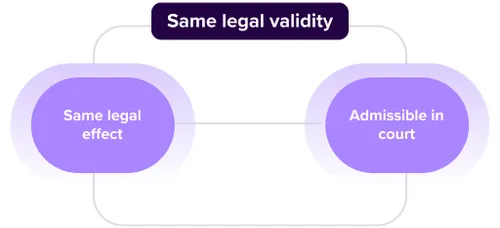
In Chile, the cornerstone underpinning the validity of digital agreements is Law 19.799 on Electronic Documents and Electronic Signatures. Enacted to modernize the legal system, this legislation enshrines the vital principle of functional equivalence, establishing that legal acts executed via electronic means have the same legal status as those recorded on paper.
Consequently, applying this legislation to real estate agreements immediately provides the following guarantees:
- Compliance with the written format requirement: A digital file fully satisfies the legal requirement that the agreement be in writing.
- Equivalent legal validity: The electronic signature confers on the document the same validity and legal effects as a traditional handwritten signature.
- Full judicial admissibility: Any Chilean civil court or tribunal is required to accept an electronic contract as legitimate evidence.
In practice, this means that signing a lease agreement online is fully recognized under current law and has absolute institutional backing. Provided that a technological platform is used to certify the identity of the parties involved and the unalterable integrity of the file, the agreement will have full legal effect. In this way, the landlord’s assets and the tenant’s rights are protected by irrefutable evidence, completely eliminating the need for in-person procedures.
Impact of the “Give Me Back My Home Act” (Law 21,461)
The landscape of real estate leasing changed dramatically with the enactment of Law 21,461, popularly known as the “Give Me Back My Home Act.” This legislation amended Law No. 18,101 on the leasing of urban properties, introducing an expedited enforcement procedure for the collection of unpaid rent and the swift repossession of the property. Before this legislation, eviction proceedings could drag on for years, whereas now the dispute can be resolved in a matter of weeks or a few months. However, for a landlord to qualify for this vital benefit of expedited eviction, the courts require extremely compelling evidence regarding the formal existence of the lease agreement.
This is where formalizing a lease agreement online becomes of paramount importance for protecting your assets. The law stipulates that, to qualify for the payment order procedure, the document must be notarized and the signatures authenticated by a notary; however, thanks to the interplay with Law 19.799, an agreement signed with an Advanced Electronic Signature (FEA) legally substitutes for notarial authentication. Having this technology is essential: if a tenant defaults on rent and the document was digitally signed in accordance with these evidentiary standards, the landlord automatically obtains the enforceable title needed to file a lawsuit immediately, effectively safeguarding their real estate investment without ever having to set foot in a notary’s office.
Benefits of Digitizing Lease Agreements in Chile
Adopting online lease agreements goes beyond mere regulatory compliance to become an indispensable operational optimization. For both real estate agencies managing multiple properties and individual landlords, digitizing this process provides immediate competitive advantages that completely transform real estate management:
- Time savings and no notary visits: It allows landlords, tenants, and guarantors to sign from their smartphone or computer at any time, reducing the time to close a deal from days to just a few minutes.
- Evidentiary security: The system captures irrefutable electronic evidence of the process, incorporating Tax ID validation, facial biometrics, IP addresses, and an exact timestamp.
- Closing deals without borders: It facilitates remote leasing, allowing investors or tenants from different regions—and even foreign nationals—to finalize the deal without needing to be in the same location.
- Prevention of Errors and Omissions: Smart platforms require all assigned fields to be completed before the document is finalized, eliminating the risk of invalid agreements due to missing signatures or blank fields.
- Long-Lasting Signature: Ensures that the online lease agreement signature retains its cryptographic validity over the years, guaranteeing that the document remains legally intact.
- Cost Reduction: Notary fees, travel costs, printing multiple copies, and physical storage (file cabinets) are eliminated, contributing to a paperless corporate policy.
- Automated Document Management: Digital documents are stored in the cloud, facilitating instant search, automated renewal, and direct delivery to email addresses.
Ultimately, understanding and implementing how to sign a lease agreement online represents a vital leap forward in property management. This modernization not only eliminates the bureaucratic friction of the physical process but also protects the landlord’s profitability and time with state-of-the-art technology.
Alquiler Seguro signs all its lease agreements with Tecalis
See how they do itStep-by-Step Guide to Signing a Lease Agreement Online
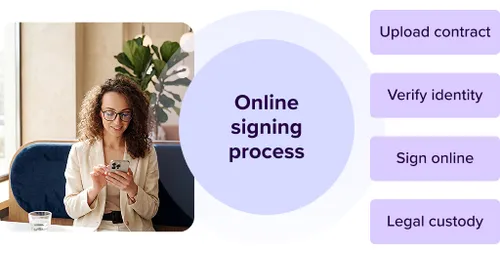
The process for completing this digital procedure is extremely streamlined and intuitive for any user. To ensure that the online lease agreement is executed without errors and with maximum legal validity, specialized technology platforms follow a structured workflow that safeguards the agreement from start to finish. Here’s a step-by-step guide to signing a lease agreement online:
- Drafting and Uploading the Document: The landlord or real estate agent drafts the agreement with all relevant clauses (rent in UF or pesos, rent adjustments, the “Give Me Back My Home” Law) and uploads the PDF file to the electronic signature platform.
- Setting up signatories: The contact information, email addresses, and phone numbers of all parties involved (landlord, tenant, and joint guarantor) are entered to activate sequential notifications.
- Strict Identity Verification (KYC): Before viewing the document, the user accesses a secure link to pass a rigorous anti-fraud check. This verification step requires a photo of both sides of the Chilean ID card, along with a real-time facial biometric verification. The system instantly compares the signer’s facial features with the photo on the official ID card, thereby blocking any attempt at identity theft.
- Signature Execution: After reliably validating their identity, each participant reads the contract on their device and provides consent via an acceptance button, a touchscreen signature, or a secure code sent via SMS (OTP).
- Audit Trail Generation and Custody: Once everyone has signed, the system cryptographically seals the file, attaches the audit trail with tamper-proof timestamps, and automatically sends the final legal copy to each party involved.
Mastering how to sign a lease agreement online through this five-step process ensures that none of the parties can repudiate the agreement in the future by claiming lack of knowledge or identity theft. By delegating identity verification and cryptographic custody to a trusted technology provider, the landlord ensures they obtain an immutable document that fully complies with the standards of Law No. 19,799. This systematized methodology transforms a process that previously required in-person coordination and long lines into a 100% digital experience, safeguarding real estate assets with electronic evidence ready to be presented and admitted in any Chilean court.
Simple Electronic Signature (FES) vs. Advanced Electronic Signature (FEA) for Leases
When looking for solutions to sign a lease agreement online, you’ll notice that the market offers different levels of digital signatures. Law 19.799 primarily distinguishes between two: the Simple Electronic Signature (FES) and the Advanced Electronic Signature (FEA). Understanding the difference is vital for protecting your assets.
| Feature | Simple Electronic Signature (FES) | Advanced Electronic Signature (FEA) |
|---|---|---|
| Definition | Any sound, symbol, or electronic process associated with a document to identify the signer. | A signature certified by an accredited provider (Certification Authority), created using means that the signer maintains under their exclusive control. |
| Identification | Basic or medium level. May be based solely on an email address or a screen signature. | Very high level. Requires thorough in-person identity verification or high-precision biometrics / ClaveÚnica. |
| Integrity | Protects the document, but the burden of proof falls on the person presenting it before a judge. | Guarantees absolute integrity. Presumption of validity: It is presumed to be legally valid; if someone disputes it, they must prove it is false. |
| Use in Leases | Valid for simple lease agreements, internal agreements, or payment receipts. | Highly recommended for formal contracts. Required to replace the notary under the “Give Me Back My Home Act.” |
Which one should you choose for your online lease agreement?
Although the Simple Electronic Signature (FES) is legally valid for formalizing an online lease agreement under the principle of functional equivalence, the expert recommendation is unequivocal. To effectively protect your investment, it is essential to use high validation standards, opting for an Advanced Electronic Signature (FEA) or, failing that, a strengthened FES.
The risk of opting for a basic solution lies in the possibility that the document could be repudiated. If you face a delinquent tenant in the future, a simple “digital scribble” drawn on the screen could easily be rejected in court. In contrast, an agreement backed by facial biometrics, ID validation, and cryptography reliably identifies the signer.
This evidentiary robustness is crucial in light of current regulations, especially the “Give Me Back My Home” Law. In scenarios requiring the rapid repossession of the property, the FEA serves as the ultimate safeguard to enable an expedited payment order proceeding, acting before the courts as the perfect legal equivalent of a notary public.
| To optimize the online lease agreement, it is essential to include a digital notification clause. Establishing this email address allows for the sending of collection notices or termination notices with full legal validity, streamlining procedures without relying on physical certified letters. |
|---|
Securely Finalize Your Lease Agreements
Today’s real estate sector leaves no room for loose ends. Choosing the right technology makes the difference between a streamlined process and a protracted legal dispute. To implement everything described in this article, you need a specialized technology partner. This provider must ensure comprehensive regulatory compliance, far beyond the simple act of signing. This is where Tecalis Sign stands out as the definitive solution. The platform allows you to manage the entire lifecycle of a lease agreement online. It does so with the highest technical and legal rigor required at the international level. By using this software, you implement a secure ecosystem that combines:
- State-of-the-art biometrics: Ensuring that the person behind the screen is truly who they claim to be, eliminating the risk of fraud.
- ID document validation: Automatic scanning and real-time verification of the ID card’s authenticity.
- Electronic signature with full evidentiary validity: Strictly complying with Law 19.799 to give the document irrefutable legal force.
- Long-Term Signature: Guaranteeing that contracts remain intact and auditable over the years, regardless of technological advancements.
Modernizing property management is now a fundamental necessity. You must optimize your clients’ time and protect your assets under laws such as “Give Me Back My Home.” To achieve this, now is the time to take the definitive digital leap. The way you sign a lease agreement online determines the security of your investment. Close your deals seamlessly and without in-person paperwork. Ensure maximum legal certainty by relying on this advanced technological solution.
Frequently Asked Questions (FAQs)
- Is it legal to sign a lease agreement online in Chile? Yes, it is completely legal. It is supported by the principle of functional equivalence established in Law 19.799, which grants electronic documents the same validity as paper ones.
- What type of electronic signature do I need for a lease? Although the Simple Electronic Signature (FES) is valid, experts recommend using an Advanced Electronic Signature (FEA) or an FES with biometric validation to ensure maximum asset protection and prevent repudiation.
- How does signing a lease agreement online help under the “Give Me Back My Home” Law? Having a digital contract with robust signatures and traceability provides irrefutable evidence in court, which significantly speeds up the expedited collection proceedings to recover the property.
- Does an online-signed lease lose its validity over time? No, as long as the technology platform uses the Longeva Signature standard, which cryptographically protects the document so that its validity endures indefinitely. |
Upload, send, and sign your lease agreements in minutes with Tecalis Sign
Try it here