











Index
- What is the Internal Revenue Service (SII) and what is its role?
- The Role of the Digital Certificate and Electronic Signature with the SII
- Common Mistakes and Risks in Digital Management with the SII
- Optimize and Secure Your SII Filings
'/%3e%3cpath%20d='M13.6641%205.76325L30.0315%2018.448M50.9456%205.30859L31.8502%2019.8575L30.0315%2018.448M13.6641%2031.6784L30.0315%2018.448'%20stroke='white'%20stroke-width='2'%20stroke-linecap='round'%20stroke-linejoin='round'/%3e%3cpath%20d='M34.5781%2017.582L50.9456%2031.2216'%20stroke='white'%20stroke-width='2'%20stroke-linecap='round'%20stroke-linejoin='round'/%3e%3cdefs%3e%3clinearGradient%20id='paint0_linear_137488_197253'%20x1='12.75'%20y1='5.60216'%20x2='38.5997'%20y2='41.6392'%20gradientUnits='userSpaceOnUse'%3e%3cstop%20offset='0.161458'%20stop-color='%23FF8066'/%3e%3cstop%20offset='1'%20stop-color='%237756DB'/%3e%3c/linearGradient%3e%3c/defs%3e%3c/svg%3e)
The best content in your inbox
Any entrepreneur or company starting business operations in Chile must have a crystal-clear understanding of what the SII is. Gone are the days of in-person procedures filled with paperwork; today, tax compliance requires seamless interaction with highly stringent digital platforms. To avoid fines and penalties in these digital environments, companies need to implement impeccable security standards, operate with validated identities, and use fully robust electronic signatures.
Throughout this article, we’ll take an in-depth look at what the SII (Internal Revenue Service) is and what its main functions are. You’ll discover the key procedures required by this institution and how mandatory electronic invoicing directly impacts your business. If you’re looking to understand how the national tax authority operates, you’ll find definitive answers here—and you’ll also discover why it’s vital to use long-lasting signature technologies to successfully pass audits.
Is your company 100% prepared to meet the SII’s requirements?
Talk to an expert and clear up any doubtsWhat is the Internal Revenue Service (SII) and what is its role?
The Internal Revenue Service (SII) is the Chilean government agency responsible for administering, enforcing, and auditing all domestic taxes that finance the country. Reporting directly to the Ministry of Finance, its primary objective is to ensure that both individuals and legal entities properly fulfill their tax obligations, guaranteeing equitable, proportional, and transparent tax collection.
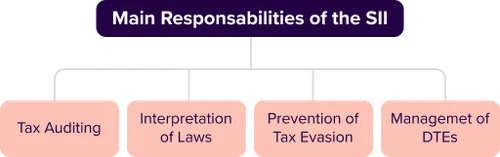
In addition to its strict oversight role, this institution acts as a regulatory body that interprets tax laws, prevents tax evasion, and facilitates compliance through an advanced technological system. In this way, it supervises the entire tax lifecycle of businesses, from the start of operations and the issuance of invoices to the filing of annual income tax returns and the payment of VAT. To fully understand what the SII is, you must view it not only as the tax enforcement authority but also as the digital engine that authenticates and validates absolutely all formal commercial activity within the national territory.
| The role of the SII (Internal Revenue Service) is not to collect or hold physical tax revenue—a task exclusively handled by the General Treasury of the Republic (TGR). Its true mission lies in determining each taxpayer’s obligations, digitally monitoring commercial transactions, and ensuring that no one evades their financial responsibilities. |
|---|
Main Functions and Powers of the SII
The responsibilities of the SII in Chile go far beyond mere oversight. To ensure the proper functioning of the national tax system, the law grants this agency a series of key powers that regulate and facilitate the entire economic cycle of taxpayers.
| Role of the SII | What It Encompasses | Case Study |
|---|---|---|
| Tax Administration | Administering domestic taxes established by law. | VAT, income tax, and excise taxes. |
| Tax Audit | Analyze tax returns to detect anomalies or inconsistencies. | Cross-checking information, audits, summonses. |
| Support and guidance | Provide information and direct assistance to taxpayers. | Manuals, online support, and answering inquiries. |
| Certification | Generate and issue official tax documents. | Certificate of tax compliance. |
| Digitization | Facilitate processes and documentation electronically. | Electronic invoicing, fee statements, online tax returns. |
Its main functions are:
- Issuance of the RUT: It is the sole entity responsible for issuing the Unique Tax Identification Number (RUT), the essential identification number required for any individual or legal entity to formally begin commercial activities.
- Tax enforcement and prevention of tax evasion: The SII monitors taxpayer behavior through cross-checking of information and audits. Its objective is to verify that tax returns reflect economic reality, thereby preventing tax evasion and protecting the State’s resources.
- Tax Collection and Control: Although the General Treasury of the Republic collects the actual funds, the SII determines, assesses, and issues the taxes due, overseeing Value-Added Tax (VAT), Income Tax, excise taxes, and property taxes.
- Administrative Interpretation of Tax Laws: The SII issues circulars, official letters, and resolutions that dictate how tax laws should be interpreted and applied in Chile, providing legal certainty to taxpayers.
- Taxpayer Guidance and Assistance: It provides guidelines and service channels to answer questions and facilitate tax compliance for individuals and businesses.
- Control of the Digital Ecosystem (DTE and Traceability): It authorizes and validates the issuance of electronic documents (invoices, receipts). This centralization allows for the organization of commercial transactions in the Register of Purchases and Sales, generating automatic proposals for tax returns.
All of these powers are exercised through highly digitized platforms, which allow the tax authority to analyze millions of pieces of financial data in real time. For companies, this monitoring capability means that any invoicing error or discrepancy in tax returns will be detected almost immediately. Due to this comprehensive oversight, the Internal Revenue Service (SII) requires companies to maintain absolute rigor in their management, compelling them to support their operations with verified identities and technological tools that guarantee the complete integrity of their accounting information.
Key Procedures Handled by the SII Chile
Operating formally in the domestic market requires constant interaction with the SII Chile’s online platforms. To maintain up-to-date tax compliance, both individuals and companies must periodically fulfill various digital requirements. Below, we detail the ten most critical procedures carried out with this agency:
- Commencement of Activities: This is the formal affidavit in which an individual or company notifies the authority that it will begin conducting commercial activities likely to generate taxable income.
- Accreditation of Legal Representatives: This involves officially registering individuals who have the authority or mandate to act, represent, and sign legally on behalf of a company.
- Obtaining and verifying the digital certificate: A mandatory step to authenticate the taxpayer. Without this file, it is impossible to register in invoicing systems or sign valid tax documents.
- Registration as an electronic invoicer: The process that formally authorizes the company to begin issuing and receiving Electronic Tax Documents (DTE) in the formats required by law.
- Authorization of serial numbers or electronic stamping: A digital process through which the official sequential numbering to be used on the company’s invoices, receipts, and shipping documents is requested and authorized.
- Issuance of Electronic Invoices and Receipts (DTE): This involves the recording, transmission, and validation of each sale made. All documents in XML format must be accepted by the tax authority’s servers.
- Monthly Returns (Form 29): The most important monthly procedure for businesses, in which Value-Added Tax (VAT), withholding taxes on fees, and Monthly Provisional Payments (PPM) are reported and paid.
- Income Tax Filing (Form 22): The major annual tax process in which companies and individuals report their income for the previous fiscal year to determine the final income tax liability.
- Modification and Update of Information: Requirements for reporting corporate changes, updating a business address, opening branches, or expanding the scope of business operations.
- Termination of Business Operations: The formal process by which the permanent cessation of business operations is notified, certifying that the company is dissolved without leaving any outstanding tax debts with the government.
Completing these procedures without errors is vital for your business. Given the strict digitization of the Internal Revenue Service (SII), using secure document management systems and reliable electronic signatures is an unavoidable legal obligation.
| Your Tax ID and Digital Certificate are equivalent to your notarized signature. Instead of sharing your passwords with your accountant, use the “Delegation of Powers” feature on the SII portal. This allows you to assign specific permissions in a 100% secure and auditable manner. |
|---|
The Role of the Digital Certificate and Electronic Signature with the SII
Understanding what the SII is requires recognizing that we are dealing with a fully digitized tax environment, where the use of digital identity is absolutely non-negotiable for any business. In this context, the digital certificate functions exactly like your virtual ID card when dealing with the authorities. Its use is strictly mandatory for centralizing operations and unequivocally authenticating both the taxpayer and a company’s legal representatives, and it is an essential requirement for validly issuing, receiving, and signing Electronic Tax Documents (DTE).
However, when operating on the SII Chile platforms, simply applying a basic digital signature is not enough. Companies generate thousands of invoices and accounting files in XML format each year, which must be legally retained for years. It is precisely in this scenario that the concept of a long-term signature becomes absolutely vital to protect the company’s assets and ensure that the documents do not lose their evidentiary value with the SII (Internal Revenue Service) over time.
To ensure maximum technical and legal security, long-term signature technology provides the following critical benefits when dealing with the tax authority:
- Permanent legal validity: Ensures that the legality and authenticity of an electronically signed document remain completely intact over the years.
- Protection against expired certificates: Ensures the evidentiary validity of the XML file even if the original digital certificate used to sign it has expired or been revoked.
- Secure support during tax audits: Prevents the rejection of expenses, the voiding of invoices, and the imposition of severe fines during audits that occur several years after the document’s issuance.
- Rock-solid evidentiary technology: The timestamp and the certificate’s status at the time of signing are permanently embedded in the file, providing foolproof legal support.
Protect your corporate identity and ensure the legal validity of your XML files with secure signature technology
Learn about Tecalis SignTax Obligations and Electronic Invoicing for Chilean Companies
Compliance with commercial law requires adopting a strictly technology-based management model. Regulations from the Chilean Internal Revenue Service (SII) require taxpayers to master two critical and mandatory phases of their daily operations: the correct electronic issuance of sales receipts and the secure digital storage of all this information over the years.
In the first of these phases, the SII in Chile mandated electronic invoicing for all companies, permanently eliminating paper invoice books. This necessitated the transition of invoices and shipping documents to the structured XML format. While this modernization streamlines transactions and reduces costs, it also places a significant cybersecurity responsibility on taxpayers. To operate under this demanding standard, businesses need to implement robust electronic signature and identity verification systems that are foolproof against any vulnerabilities or audits.
On the other hand, issuing the documents is only the beginning. The Tax Code requires that accounting information be retained for a period of three to six years. This mandates the secure storage of the original XML files, ensuring that their electronic signatures remain valid over time. A common mistake is to save only the PDF; however, for the SII (Internal Revenue Service), this format lacks probative value, with XML being the only irrefutable legal proof. Failure to present these properly safeguarded files during an audit exposes the company to substantial fines and severe administrative penalties.

Common Mistakes and Risks in Digital Management with the SII
Despite the technological conveniences offered by the SII in Chile, many companies make serious mistakes in their digital management due to a lack of knowledge or adequate tools. These are the most critical risks you must avoid:
- Identity theft when delegating procedures: Providing a copy of your digital certificate and password to third parties to access the SII tax service poses a massive risk. If a third party issues fraudulent invoices in your name, the legal and criminal liability will fall directly on you.
- Loss of legal validity due to expired signatures: Storing signed XML files without using long-term validity (LTV) signature technology is a critical mistake. When your digital certificate expires, the signatures on your historical documents could be deemed invalid in future audits, completely nullifying their evidentiary value.
- Lack of control over invoice receipt: Companies have eight days to accept or reject an electronic document issued by a supplier. Failing to monitor this process may force you to accept and pay VAT on services you never requested, seriously affecting your cash flow.
- Storing Only the PDF Version of the Invoice: Many companies forget to save the original XML file. In the event of a tax audit, the PDF format carries no tax weight; if you do not submit the validated XML file, the tax authority will assume the document does not exist and impose severe fines.
- Inconsistencies due to manual data entry: Entering information by hand on tax portals greatly increases the risk of typos. This creates automatic discrepancies between your internal accounting records and the records maintained by the government, which almost always triggers an audit.
- Reporting personal expenses as business purchases: This involves requesting an invoice in your business’s name to purchase goods or services unrelated to your commercial activity. The SII classifies this as “rejected expenses” and easily detects these irregularities, leading to audits and fines.
- Closing the business without filing the Termination of Business Operations form: Ceasing operations without formally notifying the SII is a very serious mistake. The system will assume you are still active and will begin imposing monthly fines for failing to file your VAT returns (Form 29), resulting in a massive debt.
Preventing these mistakes is absolutely essential to ensuring the financial and legal health of your business.
Optimize and Secure Your SII Filings
To successfully navigate the demanding regulations of the Internal Revenue Service (SII) and avoid costly fines resulting from operational errors, advanced technology is your best ally. Tecalis Chile positions itself as the strategic partner for companies seeking to automate their tax compliance with the highest levels of security. Through solutions like Tecalis Sign, we guarantee the application of long-term signature technology to all your tax documents in XML format, as well as to corporate contracts and minutes. This ensures that your accounting records will maintain 100% evidentiary validity and remain fully auditable years after their issuance—regardless of whether the original digital certificates have expired—providing absolute peace of mind in the event of any tax audit.
In addition to ensuring the long-term validity of documents, it is vital to protect access to these critical operations through corporate identity verification (KYC and KYB). With Tecalis’ biometric and document validation technology, you ensure that only strictly authorized personnel have access to tax management, completely mitigating the risks of fraud or identity theft when delegating procedures. This layer of security is enhanced by seamless integration through our APIs, allowing you to connect document issuance, signing, and storage directly to your ERP or invoicing system. This eliminates the risks associated with manual data entry and ensures strict compliance with SII deadlines, safeguarding full legal traceability in hyper-secure cloud environments.
Ultimately, mastering the requirements of Chile’s SII makes the difference between a vulnerable business and one that’s ready to scale. By delegating this operational burden to a comprehensive technological infrastructure, you eliminate tax uncertainty and fortify your corporate processes. This allows you to focus your time and strategic resources exclusively on growing your business, with the absolute certainty that your relationship with the government is protected and that you’re always one step ahead of any audit.
Frequently Asked Questions (FAQs)
- What exactly is the SII, and what is its purpose? The SII is Chile’s Internal Revenue Service. Its primary function is to administer taxes, issue and verify electronic tax documents (DTE), manage accounting records and tax returns, and provide online access for taxpayers. In short, it facilitates the collection, audit, and traceability of the tax and accounting operations of individuals and legal entities.
- What documentation is required to set up an account with the SII**?** To begin using the SII, you must have your login credentials, a valid digital certificate, and, in many cases, verify your basic taxpayer information (RUT, business name, and address). Depending on your legal structure, you may be asked to provide the company’s articles of incorporation, powers of attorney, and contact information. Always review the official regulations applicable to your specific situation and keep your personal passwords strictly confidential.
- How can I check the status of my transactions with the SII? By logging into the SII’s web platform with your personal credentials, you can monitor your requests and DTE submissions. Go to the “My Transactions” or “Taxpayer Inquiry” sections to directly review the current status of your electronic invoices, tax returns, and certificates.
- How do I recover my password or unlock my SII account? If you forget your password, use the recovery option on the official portal. If your account is locked for security reasons, the system will ask you to verify your identity to restore access. If the problem persists, contact SII technical support.
Simplify your tax management, avoid audits, and focus on growing your business
Request a free demo