










Index
- What is synthetic identity fraud?
- How does the creation of a synthetic identity work?
- The Impact of Identity Fraud on Business and the Financial Sector
- How to Detect and Prevent Synthetic Identity with an Advanced Anti-Fraud System
- Proof of Life and Biometric Verification
- Regulatory Framework and Compliance: KYC and AML Against Synthetic Fraud
- Current Challenges in Detecting Synthetic Identity Fraud
- Solutions for Reducing Friction and Eliminating Identity Fraud
'/%3e%3cpath%20d='M13.6641%205.76325L30.0315%2018.448M50.9456%205.30859L31.8502%2019.8575L30.0315%2018.448M13.6641%2031.6784L30.0315%2018.448'%20stroke='white'%20stroke-width='2'%20stroke-linecap='round'%20stroke-linejoin='round'/%3e%3cpath%20d='M34.5781%2017.582L50.9456%2031.2216'%20stroke='white'%20stroke-width='2'%20stroke-linecap='round'%20stroke-linejoin='round'/%3e%3cdefs%3e%3clinearGradient%20id='paint0_linear_137488_197253'%20x1='12.75'%20y1='5.60216'%20x2='38.5997'%20y2='41.6392'%20gradientUnits='userSpaceOnUse'%3e%3cstop%20offset='0.161458'%20stop-color='%23FF8066'/%3e%3cstop%20offset='1'%20stop-color='%237756DB'/%3e%3c/linearGradient%3e%3c/defs%3e%3c/svg%3e)
The best content in your inbox
The rapid evolution of financial crime has left behind the days when the physical theft of a credit card was institutions’ biggest concern. Today, the most silent and destructive threat to the foundations of digital banking, insurance companies, and fintech platforms has a name: synthetic identity fraud. Driven by increasingly sophisticated scammers operating in the shadows of the digital landscape, this crime has established itself as the fastest-growing globally, causing annual losses exceeding billions of euros.
The gravity of the situation is evident in recent industry studies, which indicate that this type of fraud currently accounts for more than 80% of fraud in the opening of new accounts. In light of this challenge, this article will break down the anatomy of synthetic fraud, its profound economic impact, and, most importantly, how companies can implement a robust anti-fraud system capable of eradicating this threat without compromising agility or the quality of the user experience.
Request a demo of Tecalis anti-fraud controls
Free demoWhat is synthetic identity fraud?
Synthetic identity fraud is a highly sophisticated type of financial crime in which an attacker fabricates a completely new digital identity by combining pieces of real information—often stolen from data breaches—with invented or fictitious elements.
This criminal method generates a hybrid profile that, although it does not fully correspond to a real person, manages to pass validation in transactional databases, credit bureaus, and digital onboarding platforms, presenting itself as a legitimate, creditworthy, and fully traceable customer. Unlike conventional cyberattacks that seek to breach IT perimeters through brute force or malware, synthetic identity exploits methodological vulnerabilities in current verification processes. By using a real identifier (such as a Social Security number, ID number, or CPF) associated with a made-up name and a fake physical address, criminals exploit the information asymmetries between corporate entities and government databases. This allows the profile to “grow,” build a history, and gain trust in the financial sector without triggering any traditional identity theft alarms, since there is no human victim to detect or report the unauthorized use of their complete data.
Difference Between Synthetic Identity Fraud and Traditional Identity Theft
To understand why conventional defenses and security systems fail against this method, it is crucial to distinguish it from classic identity theft. The key difference lies in the nature of the victim and the financial sector’s ability to react to anomalous behavior. Legacy risk engines are not programmed to detect customers who simply do not exist in the physical world. This technological limitation leads us to identify the following two major operational differences:
- Traditional identity theft: The fraudster impersonates a real, existing person (the victim). They take control of their accounts, use their credit card, or apply for loans in their name. The warning comes early: the real victim usually notices suspicious activity, unrecognized charges, or credit inquiries, and alerts their bank.
- Synthetic identity fraud: There is no direct, immediate human victim to raise the alarm. Since the created identity is fictitious (even if it uses a real Social Security number paired with a fake name and a made-up address), no one receives notifications or bank statements.
Consequently, this absence of a human victim makes synthetic fraud completely invisible to conventional alerts. Since there is no consumer to report the impersonation, the financial institution becomes the sole direct victim, mistakenly classifying the future financial loss as a simple credit “default” rather than identifying it as a coordinated attack.
Unlike traditional identity theft, where there is a physical victim who alerts authorities to the fraud, in synthetic identity theft the financial institution is the sole direct victim. Since there are no consumer complaints, the system often misclassifies these losses as “credit defaults,” obscuring the true scope of a coordinated technical offensive.
How does the creation of a synthetic identity work?
Synthetic fraud is not an impulsive event, but a long-term, methodical “cultivation” process. Criminal organizations manage these operations as if they were corporate businesses. The anatomy of creation follows a defined structure:
- Collection of real fragments: Through underground networks or massive institutional data breaches, criminals obtain legitimate unique identifiers (such as identity documents or equivalents of ID/Tax ID numbers in Europe) belonging to profiles with no credit history: children, the elderly, or deceased individuals.
- Profile fabrication: The attacker links that inactive real number to a fictitious name, an altered date of birth, and a convenience address (post office boxes or addresses controlled by money mules).
- Building a credit history: This is the critical phase. The criminal applies for low-value loans or store cards with minimal checks. Initially, these applications are rejected, but this rejection registers the “synthetic person” with the credit bureau. Over time, they apply for small loans and, surprisingly, pay them off on time for months or years. This generates an excellent credit score.
- Examples of how this works: Once the synthetic identity has reached a high credit limit across multiple institutions, the fraudster drains the maximum balance through cash withdrawals, luxury purchases, or cryptocurrency transfers and disappears without a trace. The account goes into default, and the financial institution discovers—too late—that the customer never existed.
| Characteristic | Traditional Identity Theft | Synthetic Identity Fraud |
|---|---|---|
| Nature of the Profile | Impersonation of a real person. | Creation of a fictitious/hybrid identity. |
| Fraud Detection | Early (based on a report from the victim) | Late (after the credit has been “exhausted”). |
| Credit History | Based on the victim’s prior activity. | Artificially “cultivated” over months or years. |
| Use of AI | Mainly for phishing/malware. | Creation of hyper-realistic faces and documents. |

The Role of Artificial Intelligence in Identity Fraud
The emergence of Artificial Intelligence has greatly democratized and accelerated the commission of this financial crime, transforming what once required complex physical tools and expert forgers into a simple matter of advanced algorithms and sequences of prompts. In this new technological landscape, the use of deepfakes and synthetic biometrics has become the primary weapon of criminal networks. By using Generative Adversarial Networks (GANs), attackers can now generate hyper-realistic faces of people who do not exist, whose textures and proportions easily bypass the basic static photo capture controls implemented in conventional customer onboarding processes. Taking this threat a step further, facial cloning and replacement techniques allow these computer-generated faces to be embedded into real-time video streams, giving scammers the ability to mimic human gestures and systematically deceive video call verification platforms that lack modern cognitive barriers.
In parallel with biometric impersonation, AI facilitates the automated generation of documents at scale, enabling the forgery of utility bills, pay stubs, and passports with extreme precision. By mathematically altering security patterns, metadata, and invisible watermarks in PDF and JPG files, these synthetic documents manage to pass traditional optical audits without raising suspicion. This formidable computational power means that fraudsters no longer build identities one by one, but rather deploy and activate them in blocks of thousands, triggering a technical avalanche that renders manual detection approaches completely ineffective.
The Impact of Identity Fraud on Business and the Financial Sector
Synthetic fraud has transcended the label of a mere security incident to become a structural economic risk. By masquerading as a traditional credit risk, many corporations fail to grasp the true impact of this threat until their delinquency rates spike inexplicably and compromise the organization’s operational profitability.
- Direct economic losses and risk scalability: According to Deloitte, losses from AI-driven fraud are projected to reach $40 billion by 2027. Unlike credit card fraud, mature synthetic identity allows for the theft of massive sums in mortgage loans and high-value asset financing for each profile created.
- Degradation of scoring and machine learning models: The infiltration of fake data into the financial sector causes “contamination” of risk algorithms. By processing synthetic profiles as if they were creditworthy customers, machine learning is distorted, which undermines the accuracy of scoring for legitimate users and weakens the effectiveness of any conventional anti-fraud system.
- Reputational and business relationship impact: B2B platforms and SaaS services face serious consequences when the presence of fictitious profiles is recurrent. A breach of this kind erodes institutional trust, increases operational rates with payment providers, and can lead to severe regulatory sanctions or the suspension of critical services.
The proliferation of fabricated identities not only drains financial resources but also jeopardizes the integrity of the global digital market. Companies must understand that they are not facing isolated instances of non-payment, but rather a coordinated technical offensive that requires a complete reassessment of their trust and security protocols.
Fraudsters operate with unusual patience, building the credibility of the fictitious identity over months or years. During this time, they conduct small transactions and pay all their debts on time to deceive risk algorithms. Once the system grants them maximum trust and high credit limits, they apply for massive loans and withdraw all the capital simultaneously, vanishing before the institution realizes the customer never existed.
How to Detect and Prevent Synthetic Identity with an Advanced Anti-Fraud System
Addressing a hyper-sophisticated threat requires moving beyond one-dimensional methods. Traditional database queries are no longer effective because the synthetic identity itself plants that information in public records beforehand. Modern defense relies on an advanced, multi-layered anti-fraud system:
- In-depth document validation: An advanced verification system not only extracts the text (OCR) but also subjects the ID document to dozens of tests: microprint analysis, holograms, machine-readable zones (MRZ), pixel alteration analysis, and discrepancies in image compression patterns that reveal AI-based manipulations.
- Behavioral and digital signal analysis: This involves closely monitoring the device’s footprint and user telemetry. The system assesses whether the applicant types their name from memory or uses copy-and-paste shortcuts, whether they browse through an anonymous VPN, or whether their email account was created just five minutes ago. Real identities have an organic history and digital "clutter," while synthetic ones are suspiciously perfect and lack a temporal trail.
- Link analysis: This involves using AI to cross-reference data at scale and uncover hidden illicit relationships. For example, it allows for the instant detection of whether multiple purported customers, with different names and documents, are using the same contact phone number, sharing the same physical device, or connecting from the same IP range.
Integrating these three technological dimensions is the only viable way to thwart attacks by today’s digital mafias. By simultaneously validating forensic authenticity and the consistency of online behavior, companies can neutralize fraud before it manages to infiltrate their financial infrastructure.
Verify your identity with Tecalis KYC
Try it nowProof of Life and Biometric Verification
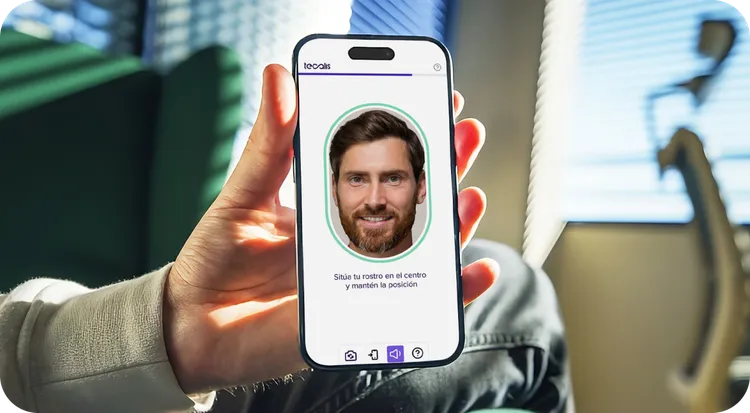
The most critical line of defense against synthetic identity and deepfake attacks lies in biometric verification. Today, static photographs or basic selfies have become completely obsolete in the face of advances in generative AI. For this reason, any modern anti-fraud system requires the implementation of advanced biometric technology capable of distinguishing reality from a computer simulation.
The core of this defense lies in passive liveness detection, where the biometric engine analyzes dozens of undetectable markers in the background. By studying light reflection on the skin, micro-muscle movements, and 3D depth mapping, it verifies that a living, three-dimensional human being is present in front of the camera. Operating completely invisibly, it blocks masks or fake videos without requiring inconvenient actions, significantly improving the user experience.
As an additional security layer for financial transactions or high-risk workflows, active liveness checks are integrated. In this scenario, the platform may ask the user to perform random movements, such as smiling, blinking, or following a point with their gaze in real time. By combining this direct interaction with passive background scrutiny, the company ensures absolute legitimacy and blocks any attempt at fraud during onboarding.
Regulatory Framework and Compliance: KYC and AML Against Synthetic Fraud
Preventing synthetic identity is not just a matter of economic survival; it is a strict legal imperative under the international regulatory umbrella. Currently, AML (Anti-Money Laundering) directives and KYC protocols require financial institutions, fintech platforms, insurers, and cryptocurrency exchanges to reliably verify the true identity of their users. This legal framework requires the deployment of a robust anti-fraud system to monitor transactions and continuously assess the level of risk associated with money laundering or terrorist financing, blocking access to any fictitious profile from the outset.
To ensure regulatory compliance and protect operations, the regulations are based on the following structural pillars:
- The eIDAS Regulation: Establishes binding standards for electronic identification and trust services within the European Union. Companies are required to integrate verification platforms that offer high levels of technical assurance, fully aligning with the requirements of eIDAS 2.0 and the comprehensive development of the European Digital Identity.
- The Qualified Trust Service Provider (QTSP): To prevent tampering with contract signatures and service registrations, having a Qualified Trust Service Provider is vital. This entity ensures that remote video identification and digital signature processes have full evidentiary validity in court in the event of a dispute. It should be noted that non-compliance with this set of regulations, including the AMLD directives, results in fines in the millions and severe penalties from national and international regulators.
Current Challenges in Detecting Synthetic Identity Fraud
The biggest dilemma facing the financial sector today lies in balancing security with friction during digital onboarding. Historically, adding verification controls slowed down registration, leading to massive abandonment rates in favor of competitors. To make matters worse, the traditional systems responsible for this slowness operate with static binary rules that are useless for detecting a well-constructed synthetic identity, also generating a high volume of false positives that mistakenly reject legitimate customers.
Overcoming this dual challenge of inefficiency and friction requires implementing a specialized anti-fraud system for advanced onboarding, such as Tecalis Identity. This platform stands out for performing more than 40 comprehensive checks in the background in a completely invisible manner. By combining forensic document checks, 3D liveness detection, and AI-powered risk assessment, it neutralizes deepfakes in real time, ensuring maximum protection without adding delays to the user experience.
Solutions for Reducing Friction and Eliminating Identity Fraud
Achieving the ideal balance between impenetrable security and an excellent user experience is possible thanks to secure digital onboarding. This approach enables near-instant approvals while artificial intelligence orchestrates multiple invisible validations in the background. Instead of verifying isolated attributes, these technologies comprehensively analyze biometrics and documentation, cross-referencing data in milliseconds with government records and international sanctions lists. This immediate response allows for individual risk assessment and dynamic adaptation of the registration flow in real time.
Implementing a system with these features offers immediate competitive and operational advantages for any financial or technology institution:
- Drastic reduction in drop-off rates: By simplifying verification and natively integrating it into any device, unnecessary friction points are eliminated, maximizing conversion and facilitating the acquisition of high-quality customers without delays.
- Comprehensive and guaranteed regulatory compliance: These solutions ensure full alignment with KYC, AML, and eIDAS regulatory frameworks, legally shielding the company from potential audits or penalties for lack of due diligence in user identification.
- Proactive protection against financial fraud: Synthetic identity threats are eradicated at the most critical point in the customer lifecycle, preventing capital outflows and protecting the company’s digital environment in the long term.
- Operational scalability and resource optimization: The automation of forensic and biometric validations reduces reliance on manual reviews, allowing the organization to increase its customer volume without driving up its compliance operating costs.
- Dynamic authentication and anomaly detection: The system introduces additional security steps only when it detects suspicious patterns, such as discrepancies between the time zone and the IP address, ensuring a smooth flow for legitimate users and an impenetrable barrier for fraudsters.
- Enhanced brand reputation: Offering a sign-up process that is perceived as secure and technologically advanced reinforces the company’s image as a cutting-edge entity, attracting a segment of customers who value the protection of their privacy and assets.
In a landscape where artificial intelligence equips criminals with unprecedented capabilities, maintaining outdated verification processes is a recipe for operational failure. Adopting advanced solutions like those we offer at Tecalis is a fundamental step toward ensuring business resilience, legal compliance, and full market confidence in the coming decade.
Frequently Asked Questions (FAQs)
- What role does AI play in synthetic identity fraud? Generative AI allows criminals to create hyper-realistic faces that do not exist (deepfakes) and forge official documents on a large scale. These forgeries are so precise that they easily fool traditional visual verification checks.
- How can companies detect and prevent synthetic identity fraud? Basic database queries are no longer sufficient. Corporations must implement an advanced anti-fraud system that combines document forensics, digital behavior monitoring, and 3D biometrics with proof-of-life verification, thereby blocking any deepfakes in real time.
- How long does it take a bank to detect a synthetic identity? It can take months or even years. Unlike a quick cyberattack, scammers are very patient: they make small purchases and pay their bills on time for a long time to gain the system’s trust. The fraud is usually only discovered when they suddenly drain their credit lines and disappear.
- How can I tell if my data is being used to create a fake identity? It’s hard to spot because they link your ID to fake email addresses and addresses so you won’t be alerted. The best way to protect yourself is to regularly check your credit history or request reports from the Bank of Spain to look for loans or cards you don’t recognize.
Learn the best methods to avoid any risk
Get started today