








Index
- How does car rental software work?
- What Are the Benefits of Digitizing Fleet Management?
- Key Software Features and Tools for Car Rental Companies
- Digital Identification and Onboarding for a Car Rental Company
- Criteria for Choosing the Ideal Platform for Your Fleet
- Legal Framework and Safety Regulations for Vehicle Rental
- Digitize Your Car Rental Onboarding with Tecalis

The best content in your inbox
Car rental software is a platform that centralizes a car rental company’s reservations, fleet management, customer information, contracts, and payments into a single system. It replaces spreadsheets and manual records and serves as the hub from which all operations are coordinated: which vehicles are available, who has reserved them, under what conditions, and with what documentation.
The mobility and car rental sector is booming, driven by the digitization of reservations and fleet management. In this article, we analyze what these platforms are, how they are transforming fleet management, and why technologies such as digital onboarding and electronic signatures are redefining industry standards globally.
Discover how the best car rental companies are operating
Download free guideHow does car rental software work?
Car rental software connects the physical inventory (the vehicle fleet) in real time with sales channels, financial administration, and customer management, coordinating the mobility company’s key operations from a single digital environment.
Most of these platforms operate using a cloud-based architecture. This means that operators, managers, and counter staff can access up-to-date information from any device with an internet connection. Real-time synchronization is key: if a vehicle is reserved through the website, the system automatically reflects the change in availability, preventing conflicts between reservations and keeping the inventory up to date.
To understand how they work technically and operationally, these platforms rely on:
Omnichannel data collection and processing: the system acts as a centralized database that instantly consolidates information from any source (web reservations, mobile apps, third-party agencies, and physical counters), eliminating duplicates.
Execution of automated operations: the platform launches workflows autonomously. For example, upon confirming a reservation, the system assigns the corresponding dynamic rate, holds the deposit, generates the legal contract, and schedules an alert for the vehicle’s physical preparation—all without manual intervention.
Modern mobility companies need tools that go beyond simply tracking check-ins and check-outs. They require a digital environment capable of connecting different areas of operations and executing processes—such as managing payments, verifying identities, measuring vehicle telemetry, and issuing invoices—all in a matter of seconds.
What Key Processes Does Car Rental Software Address?
To understand the real impact of car rental software, it’s essential to see how it streamlines daily operations by eliminating manual hurdles. First and foremost, the platform handles dynamic inventory control, allowing you to instantly monitor whether a vehicle is available, rented, in the shop, or being cleaned. This visibility enables centralized management of the entire rental process—from checking rates and availability on the website to the final return of the vehicle—streamlining check-in and check-out procedures.
Furthermore, the technology handles critical processes to protect the company’s assets through preventive and corrective maintenance. The platform generates automatic alerts based on mileage or usage time to schedule service visits, thereby extending the fleet’s useful life. Finally, the software handles incident and fine management: by cross-referencing contract histories, it automatically assigns any traffic violations or detected damage to the corresponding driver, linking the incidents to the exact date and time.
Real-time Business Intelligence features enable the calculation of ROI per vehicle, the anticipation of demand spikes, and the coordination of fleet movement between branches, supporting decisions based on data rather than estimates.
What Are the Benefits of Digitizing Fleet Management?
Making the leap to an automated management model is one of the most direct paths to improving a fleet’s profitability, especially in a market that, according to Technavio, will grow at an annual rate of between 9% and 11% through 2030. When a company integrates an advanced technology platform, its cost structure is optimized in a short time: automation reduces repetitive tasks, streamlines operations, and allows the team to focus its resources on higher-value activities. Below, we detail the benefits that justify this upgrade:
Operational scalability. A good system allows you to manage more vehicles with the same staff. By automating repetitive tasks, the team can focus on acquiring more customers and providing better service, rather than wasting hours coordinating schedules or maintaining manual records.
Enhanced security and fraud prevention: The car rental industry has historically faced security issues. Fake driver’s licenses, identity theft, and vehicle theft are daily risks that cost the industry millions. According to IDScan.net, the detection of fake IDs in the automotive sector increased by 21% in 2025 compared to the previous year. Modern software, powered by RegTech, reduces this exposure by validating the authenticity of documents before handing over the keys.
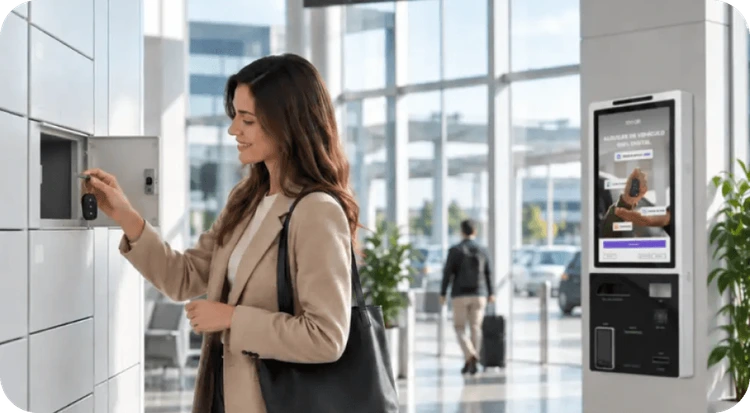
Say Goodbye to Endless Lines: The biggest pain point for a customer is arriving tired from a flight and having to wait 45 minutes at a counter to pick up their car. An efficient system enables the use of a digital check-in counter, improving customer satisfaction and fostering loyalty for future reservations.
Cost savings and improved fleet management: Ensuring traceability of the fleet’s location and availability reduces operational losses. This level of visibility makes it easier to identify idle vehicles, optimize their allocation, and prevent part of the fleet from remaining idle without generating revenue.
Simplified management of payments, invoices, and security deposits: Managing cash flows often creates administrative friction. Advanced software automates the payment gateway by handling the withholding and refunding of credit card deposits, processing charges for extra kilometers, and instantly issuing digital receipts.
Key Software Features and Tools for Car Rental Companies
When looking for high-performance car rental reservation software, it’s essential to go beyond basic booking functions. A competitive system must serve as the operational core of the business, so it’s crucial to ensure it includes the following tools and modules:
Smart booking engine: Integrates with the corporate website and is mobile-responsive. It allows customers to view real-time inventory, select extras (child seats, GPS, insurance), and pay securely online.
Real-time vehicle availability: A visual, interactive calendar allows you to instantly view and manage the status of the entire fleet, enabling agents to make changes with a simple “drag-and-drop.”
Rate management: Dynamic pricing tools that automatically adjust rates based on demand, season, availability, and competitor prices.
Customer and contract management: Complete history of each driver, including preferences, past billing, and risk level. Automated generation of rental contracts without human error.
Automated Billing and Accounting: Issuance of electronic invoices, management of deposits or deductibles held on credit cards, and direct integration with the company’s accounting software (ERP).
Telemetry and geolocation: integration with IoT and GPS devices in vehicles to monitor actual mileage, fuel levels, and driver behavior, and to remotely immobilize the car in case of non-payment or suspected theft.
Keyless entry: technology that allows users to unlock the vehicle directly from their smartphone via Bluetooth or a mobile connection, facilitating business models such as carsharing or 24/7 unattended rental.
API-First Architecture: perhaps the most important technical feature. This means the software is designed to integrate easily with other external tools (payment gateways, insurance providers, identity verification systems).
The integration of all these tools into a single, centralized platform is what sets a stagnant operation apart from a scalable business model. By having a robust technological infrastructure, mobility companies are able to reduce their administrative burden and make better use of their resources—something particularly relevant in a market that Grand View Research estimates will be worth $278 billion by 2030.
Optimize operations and onboarding for your mobility business
All the informationDigital Identification and Onboarding for a Car Rental Company
The digitization of car rentals has evolved into a model where security and agility must coexist. In this context, the customer registration phase has changed, leaving behind manual checks at physical counters. Implementing an advanced digital identification and onboarding system allows companies to validate profiles in real time, reducing the risks of impersonation and identity fraud. This transition is supported by two technological pillars that ensure a secure and legally binding process for operating the fleet.
KYC Processes and Biometrics
Identity verification through KYC (Know Your Customer) systems acts as a line of defense against document fraud and vehicle theft. During digital registration, the user scans their ID and driver’s license with their cell phone, and artificial intelligence engines analyze the authenticity of these credentials by verifying security measures and extracting data using OCR technology. This automated check immediately blocks any forged, altered, or expired documents. This is a particularly important step considering that, according to Sumsub’s identity fraud report**, forged identity documents were the most commonly detected type of document fraud in 2025**, accounting for 72% of cases—ahead of passports (13%) and driver’s licenses (10%).
To complement this document analysis, biometrics links the driver’s physical identity to the documents provided. Through a liveness check, the system requires a real-time facial scan to rule out complex fraud, such as the use of static photographs, pre-recorded videos, masks, or deepfakes. The algorithms cross-reference these facial features with the photo from the official document extracted in the previous step. Once the match is validated, the profile is verified, streamlining the car delivery process without compromising the customer experience.
Some verification engines also cross-check customer data against delinquency lists or internal incident reports, adding an additional filter before delivering the vehicle to drivers with a history of non-payment or accidents.
Car Rental Signature: The Importance of Electronic Signatures in Contracts
Completing a secure onboarding process requires formalizing the commercial agreement through a solid legal framework. An advanced electronic signature certifies the document’s integrity by collecting electronic evidence during the process, such as the IP address, geolocation, stroke biometrics, and a timestamp. This set of metadata guarantees the principle of non-repudiation, making the contract admissible in court in the event of disputes over damages, non-payment, or accidents.
At the operational level, this solution streamlines the final vehicle delivery. By sending the generated document directly to the customer’s cell phone, it facilitates remote review and acceptance of the terms before the customer arrives at the dealership, eliminating the need to sign multiple physical pages at the counter during peak demand periods.
Finally, adopting this format represents a step forward in administrative management and resource savings. All signed contracts are automatically stored in cloud repositories under encryption protocols. This “paperless” office model reduces physical storage costs and allows any legal file to be retrieved in seconds in the event of potential claims, accidents, or audits.

Criteria for Choosing the Ideal Platform for Your Fleet
Selecting the right technology solution requires evaluating multiple operational factors to ensure an optimal return on investment. Beyond the initial cost of the license, it is vital to analyze the software’s ability to adapt to the specific characteristics of the business model, prioritizing vendors that guarantee stability, support, and long-term evolution based on the following criteria:
Cloud-Native Support (SaaS): It is essential to avoid on-premises installations that require dedicated servers and costly maintenance. The SaaS model guarantees full accessibility, automatic updates, and data security in the cloud.
High Scalability: The software must operate just as smoothly and without outages, regardless of whether you’re managing a fleet of 10 vehicles or 10,000.
Usability (UX/UI): An intuitive interface reduces the learning curve for the operations team and minimizes the margin for human error, especially during peak demand periods in high season.
Localized technical support: Having a customer service team that understands the dynamics of the industry is essential, with availability to resolve issues during critical hours.
Integration Capabilities: The solution must act as a facilitator, not as a closed system. It is essential that it allow for the integration of third-party modules, such as identity verification and electronic signatures.
Ease of data migration: The technology provider must offer secure and effective protocols for transferring customer history, previous contracts, and the vehicle catalog from legacy systems without any loss of information.
Multi-device accessibility: The platform must be optimized for tablets and smartphones, allowing users to conduct damage assessments, perform inventory checks, and manage check-in/check-out procedures right next to the vehicle.
Constant regulatory updates: The software must feature proactive development that updates the system to comply with new cybersecurity and privacy standards, as well as tax and billing requirements.
Carefully analyzing these parameters before implementation prevents the system from becoming obsolete prematurely and avoids reliance on inflexible platforms. A wise choice not only optimizes current profitability but also lays the technological foundation needed to support any future expansion.
Legal Framework and Safety Regulations for Vehicle Rental
Operational digitization entails assuming significant responsibility in terms of corporate governance. Mobility companies must ensure that the processing of their users’ information serves exclusively authorized commercial purposes, automatically managing consents, access rights, and retention policies. This involves integrating specific tools for the permanent deletion of records once the mandatory retention period has ended, thereby preventing the unjustified accumulation of historical records on servers. Maintaining this control over the flow of information prevents legal contingencies and fosters an environment of transparency with auditing authorities.
The validation of any electronic transaction requires the technological support of a duly certified trusted service provider (QTSP). It is essential that the software architecture be natively aligned with the regulations governing electronic transactions specific to the jurisdiction in which the company operates, thereby ensuring an auditable workflow that safeguards operations on an international scale.
Applying the principle of privacy by design means that the system collects and processes only the data strictly necessary to complete each reservation, reducing the company’s exposure without the need for additional monthly configurations.
Digitize Your Car Rental Onboarding with Tecalis
Establishing an agile business model requires integrating software solutions that transform administrative burdens into high-performance workflows. The specialized tools Tecalis Identity and Tecalis Sign provide an infrastructure designed to optimize the daily operations of mobility companies, ensuring a seamless technological transition focused on maximizing service efficiency.
Its architecture, based on application programming interfaces (APIs), enables full interoperability with any existing enterprise resource planning (ERP) system. By orchestrating the automated capabilities of Tecalis Identity and the legal robustness of Tecalis Sign from a native cloud platform, companies ensure a scalable deployment, offering the following key advantages:
Agile and modular deployment: reduced integration times, enabling new technological components to be activated in record time without complex configurations.
Seamless experience: intuitive interfaces that boost conversion rates and improve brand perception before vehicle pickup.
Reduced operational risk: Real-time automated decision-making, minimizing the company’s financial exposure to fraud attempts or theft.
Traceability and legal backing: tamper-proof certification of agreements, along with a unified dashboard that gives the management team visibility into the status of each case.
Scalable response to demand: technical capacity to process massive spikes in simultaneous transactions during peak vacation season without latency or server outages.
Integrating these types of solutions turns security requirements into an operational advantage, reducing wait times and strengthening the protection of the company’s assets. Automating these workflows establishes an efficient, scalable business model that is prepared to handle increases in demand.
Frequently Asked Questions (FAQs)
- Are electronically signed car rental contracts legally valid? Yes. Advanced electronic signatures include evidence such as biometric signature analysis or time stamps, which guarantee the principle of non-repudiation and give the contract probative value in the event of a legal claim.
- How does digital onboarding prevent vehicle theft? By combining KYC validation and facial biometrics: the system verifies the authenticity of the ID and driver’s license and blocks forged credentials before handing over the keys.
- Why is a SaaS model more cost-effective for managing a fleet? Because it eliminates the cost of in-house servers, allows for scaling without additional investment in infrastructure, and provides real-time access to the fleet inventory from any device, with automatic security updates.
- How does the software help manage fines and damage? By cross-referencing contract history to assign each violation or damage to the responsible driver, linked to the exact date and time of the rental, without manual intervention.
- How are security deposits and billing automated? By centralizing the payment gateway: the system holds and refunds the deposit to the card, processes additional charges, and automatically issues the electronic invoice.
Combines KYC and electronic signatures into a single workflow for car rentals
Discover Tecalis’ solutions