









Index
- What are sales channels
- Types of sales channels: from the traditional model to the digital age
- How to design an effective sales channel strategy
- Channel integration and automation for an omnichannel experience
- Tips for improving your conversion rate on any channel
- Automation tools to boost your marketing channels
- How to optimize conversion in B2B sales channels
'/%3e%3cpath%20d='M13.6641%205.76325L30.0315%2018.448M50.9456%205.30859L31.8502%2019.8575L30.0315%2018.448M13.6641%2031.6784L30.0315%2018.448'%20stroke='white'%20stroke-width='2'%20stroke-linecap='round'%20stroke-linejoin='round'/%3e%3cpath%20d='M34.5781%2017.582L50.9456%2031.2216'%20stroke='white'%20stroke-width='2'%20stroke-linecap='round'%20stroke-linejoin='round'/%3e%3cdefs%3e%3clinearGradient%20id='paint0_linear_137488_197253'%20x1='12.75'%20y1='5.60216'%20x2='38.5997'%20y2='41.6392'%20gradientUnits='userSpaceOnUse'%3e%3cstop%20offset='0.161458'%20stop-color='%23FF8066'/%3e%3cstop%20offset='1'%20stop-color='%237756DB'/%3e%3c/linearGradient%3e%3c/defs%3e%3c/svg%3e)
The best content in your inbox
Sales channels are no longer simple distribution channels; they have become complex technological ecosystems. Accelerated digitization and new security regulations have transformed the way companies interact with their customers. It is no longer enough to be present on multiple platforms; the key to success lies in channel integration and eliminating friction at the point of contact.
This article takes an in-depth look at the world of marketing channels, from traditional models to the most disruptive digital strategies, with a special focus on how automation and regulatory compliance can boost your conversion rates.
What are sales channels
Sales channels are the set of media, platforms, and agents through which a company makes its products or services available to the end consumer.
When we talk about a marketing channel, we are referring to the entire journey that a product or service takes from the company to the customer, including:
- Lead capture.
- Commercial interaction.
- Contracting process.
- Identity validation and regulatory compliance.
- Contract signing.
- Customer registration and service activation.
In the era of the digital economy, the technical definition has evolved: a modern marketing channel is not just a logistical bridge, but a point of data generation and user experience.
Selling a product vs. designing an integrated sales ecosystem
Selling a product is a transactional action. Designing an integrated sales ecosystem is a strategic decision. While traditional sales focus on exchange, the ecosystem seeks omnichannel capabilities, which involve:
- Multichannel architecture: Deliberately selecting and combining different channels to cover different market segments and moments in the customer journey.
- Systemic integration: Connecting these channels to each other so they share information in real time (inventory, customer data, purchase history), offering a consistent experience no matter where the customer interacts.
- Automation and efficiency: Implementing technologies that automate repetitive tasks (onboarding, contract signing, notifications) to speed up the sales cycle and reduce errors.
- Focus on customer experience: Put the customer at the center, ensuring that every interaction on any channel is seamless, personalized, and adds value, transforming a purchase into the beginning of a long-term relationship.
- Integrated regulatory compliance from the outset: Ensure that every channel and automated process complies with data protection (GDPR) and financial security regulations.
Companies that design their channel strategy in this way achieve higher conversion rates, lower acquisition costs, and greater customer loyalty. This ecosystem is a necessity to compete in a market where agility, personalization, and user experience are decisive factors in purchasing.
Types of sales channels: from the traditional model to the digital age
The types of sales channels have evolved enormously in recent years. Today, traditional models coexist with digital and online sales channels, which allow businesses to scale up and measure each interaction.
Traditional sales channels
Traditional sales channels have been the basis of business growth for decades and remain relevant in many sectors.
Direct channels
This category includes the internal sales force, company-owned stores, door-to-door sales, and events such as trade shows, which are crucial for B2B networking. Although they guarantee complete control over brand image and margins, they present challenges in terms of operating costs, limited scalability, and complexity in measuring attribution.
Indirect channels
This includes the network of distributors, wholesalers, retailers, agents, and strategic partners. While the indirect channel is essential for scaling geographic reach and penetrating new markets, it leads to a dilution of control over the final customer experience and critical stages of the sales process.
Digital and online sales channels
Online sales channels have radically transformed the way we sell. They allow us to reach more customers, automate processes, and measure each point in the funnel. Among the most relevant are:
- Own e-commerce: The brand's online store, where it has control over data and the experience. It requires continuous investment in development, marketing, and logistics.
- Marketplaces or online markets: These function as large digital shopping centers with massive traffic, ideal for attracting customers in the discovery phase.
- Social commerce: Direct sales through social media that leverage social momentum and recommendations.
- Online sales channels for services: Subscription platforms and self-activation portals where customers manage their own registration.
In the B2B arena, Gartner estimates that 80% of complex purchases will be initiated on digital channels by 2027.
Digital sales channels stand out for their scalability, real-time measurement, onboarding automation, and reduced friction in contracting. Their main advantage is their ability to integrate with back-office systems, CRM and ERP, and regulatory compliance tools.

How to design an effective sales channel strategy
A well-designed sales channel strategy must be based on an in-depth analysis of the customer, the product, and the regulatory context. Its design should follow these steps:
- Know the customer and their behavior: Where do they look for information? Which channel do they prefer to use? What friction do they encounter in the process?
- Define the optimal channel mix: Not all products need all channels. The goal is to combine: acquisition channels, conversion channels, and support channels.
- Design the complete customer journey: From the first impact to the signing of the contract and the activation of the service.
- Automate critical processes: lead registration, identity verification, electronic signature, and certified communication.
- Measure, optimize, and scale: A channel strategy is a living process that must evolve with real data.
A modern strategy designs a hybrid model where the customer can jump between physical and digital channels without having to repeat information or lose track of their purchase.
Channel integration and automation for an omnichannel experience
The true power of modern marketing channels comes from their technical integration. The use of BSS/OSS (Business/Operations Support Systems) architectures allows business and operational flows to talk to each other.
When a company implements a Customer Hub, it unifies the user's identity across all channels:
- Unique identity and 360° view: Consolidation of data in a central repository (CRM) and digital identity and KYC solutions so that the user profile is instantly recognized at any point in the ecosystem, eliminating information silos.
- Process continuity and transactional agility: Optimization of workflows through digital onboarding platforms that allow processes initiated in one channel to be synchronized and completed in another without data loss or duplication of steps.
- Operational omnichannel and legal security: Integration of processes where identity validation at a kiosk is valid for a subsequent advanced or qualified electronic signature from a mobile device, backed by certified communication systems.
Eliminating friction in the online sales channel
Abandonment in the online purchasing process is often due to tedious registration procedures that create critical friction for conversion.
Leading companies combat this by completely digitizing customer onboarding using technologies that transform bureaucracy into a totally seamless experience. These are:
- Remote identity verification (KYC): Validates customer identity in seconds using biometrics, document scanning (OCR), and video identification, ensuring a secure process that complies with current regulations.
- AML (Anti-Money Laundering) compliance: Performs automatic checks against sanctions and PEP lists to prevent fraud and money laundering in a way that is transparent to the user.
- Digital contracting with electronic signature: Enables legally binding agreements to be concluded from any device in a matter of minutes, eliminating manual intervention and dramatically accelerating the sales cycle.
Security and regulatory compliance
In regulated sectors (finance, telecommunications, energy, real estate, and utilities), identity validation is mandatory. Regulatory compliance, more than a legal requirement, is a competitive advantage based on three key frameworks:
- eIDAS 2.0 (EU Digital Identity Regulation): Establishes levels of trust for identity and electronic signature services, ensuring the legal validity of transactions throughout the European market.
- AML6 Directive: Requires rigorous verification of customers (KYC) and beneficial owners (UBO) to prevent fraud and ensure financial transparency in every transaction.
- GDPR: Regulates the processing of personal data throughout the sales process, ensuring that user privacy is protected from the very design of the marketing channels.
Implementing Trust Service solutions builds digital trust. Customers who know that their identity and data are protected by the highest legal and technological standards are less reluctant to complete an online transaction.
Automation of sales closure
Closing is the critical phase where advanced electronic signatures act as the ultimate conversion engine. Integrating this process directly into the checkout flow allows agreements to be formalized instantly, eliminating waits and travel that often cool the purchase decision.
- Identification and validation: The system automatically verifies the lead's identity through video identification or document reading (OCR).
- Generation and signature: A personalized contract is issued in PDF format for the customer to sign with a qualified electronic signature (QES) from any device.
- Closing and registration: A certified copy is sent to the customer and the transaction is recorded in the CRM, completing in 2 minutes a cycle that previously took days.
- Legal guarantee: The use of Trust Services under the eIDAS regulation generates legal traceability and irrefutable evidence in any court of law.

Tips for improving your conversion rate on any channel
Regardless of the channel, there are cross-cutting tactics that optimize performance and allow the sales channel strategy to be truly scalable and efficient:
- Personalization of the journey: Use CRM data to offer specific offers based on previous behavior.
- Real-time response: Multichannel support (AI chatbots, integrated human support) reduces buyer hesitation time.
- Form simplification: Each additional field on a registration form reduces conversion by 10%. Automation using OCR to extract data from identity documents saves the user time.
- Use of Trust Services: Displaying trust seals and using recognized trusted service providers creates the security needed to complete high-value transactions.
Automation tools to boost your marketing channels
To scale, technology is non-negotiable. These are the tools that define leading sales companies and how Tecalis solutions facilitate this transformation:
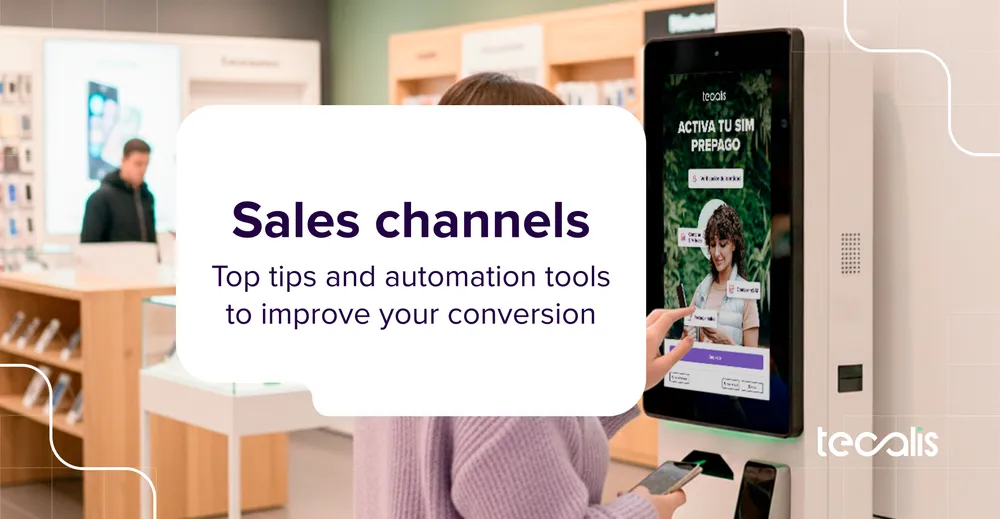
- Interactive Kiosks: Ideal for physical-digital hybridization. They allow customers to carry out complex contracting processes autonomously at physical points, with identity validation and signature integrated into the terminal itself.
- Digital Onboarding Systems: Platforms that automate KYC and KYB for B2B closings, performing biometric verifications, document scanning, and sanctions list checks in milliseconds.
- Contracting and Electronic Signature: Facilitates legally binding sales closures through advanced and qualified signatures, including Certified Communication to ensure the legal validity of each notification and interaction with the customer.
- All-in-One Platforms: Centralize the management of multiple channels in a single interface. This allows for a 360º view of the customer and agile operations that unify data, processes, and documents in a single ecosystem.
How to optimize conversion in B2B sales channels
In the B2B environment, the complexity of transactions and compliance requirements often prolong sales cycles. Tecalis transforms this scenario by eliminating bureaucratic friction through a technological architecture that connects customer acquisition with legal closure in an uninterrupted flow.
Conversion optimization is based on four strategic pillars:
Accelerating B2B Onboarding with Tecalis Identity
Tecalis Identity automates the verification of powers of attorney and KYB (Know Your Business). By immediately validating the identity of legal representatives and ultimate beneficial owners (UBOs), days of waiting in the validation phase are eliminated, allowing the business relationship to begin instantly.
Immediate and Binding Closing with Tecalis Sign
The use of advanced and qualified electronic signatures under the eIDAS standard with Tecalis Sign allows complex contracts to be formalized from any device. This prevents sales from cooling off and ensures that each agreement has complete legal traceability and irrefutable evidence.
Physical Omnichannel with Tecalis Kiosks
This Tecalis Kiosks solution allows the power of digital onboarding to be transferred to physical environments. Using interactive terminals, B2B customers can independently carry out registration, identity validation, and contract signing processes at trade shows, events, or headquarters, reducing waiting times and operating costs.
Centralized Management in the Customer Hub
By unifying all points of contact, from the sales force to strategic partners, in the Tecalis Customer Hub, companies gain a 360º view of the customer. This ensures that information flows without silos, allowing any agent to retrieve processes initiated in other channels and close the transaction with complete agility.
With this approach, Tecalis not only ensures regulatory compliance, but also drastically reduces operating costs and improves the success rate in converting corporate leads.
Glossary of terms
- Omnichannel: A strategy that integrates all of a company's channels to provide a unified and consistent customer experience.
- Qualified signature: A type of electronic signature with the highest level of security and legal validity, equivalent to a handwritten signature.
- OCR: Technology that automatically extracts data from scanned or photographed identity documents.
- UBO (Ultimate Beneficial Owner): Natural person who ultimately owns or controls a legal entity (beneficial owner).
- Trust Services: Electronic services that guarantee the integrity and authenticity of data in digital transactions.
Improve the performance and results of your sales channels
Free expert advice here