





Index
- What is Future Utility, and why is it key for the energy sector?
- The Energy Sector’s Meeting Place in Madrid
- The Five Pillars That Will Shape the Future of Utilities
- Tecalis at Future Utility 2026: Our Experience at the Event
- The Tecalis Team’s Takeaways from Future Utility 2026
- What Energy Retailers Should Prioritize in 2027

The best content in your inbox
The ninth edition of Future Utility has once again cemented Madrid’s position as the epicenter of innovation and digital transformation in the energy sector. With a rapidly evolving market and the recent entry into force of Royal Decree 88/2026, electricity, gas, and water companies face critical challenges in cybersecurity, regulatory compliance, and customer experience.
In this article, we review what was discussed at Future Utility 2026, the key takeaways for our team, and what energy retailers should prioritize heading into 2027 following the entry into force of Royal Decree 88/2026.
Everything That’s Changing with Royal Decree 88/2026 Regarding Energy Contracts
Watch the webinar on Royal Decree 88/2026What is Future Utility, and why is it key for the energy sector?
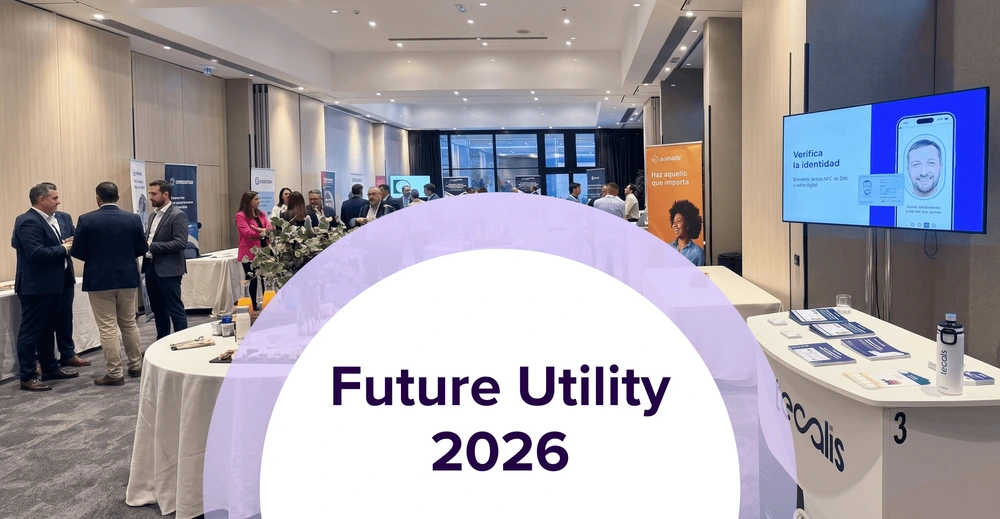
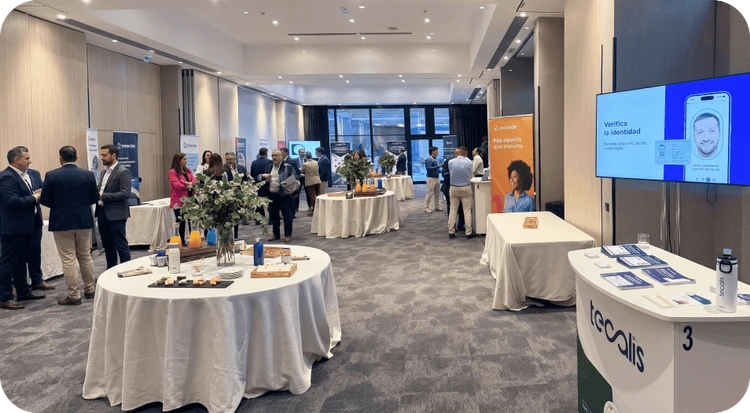
Future Utility is the leading annual gathering for the utilities sector in Spain: a meeting place for electricity, gas, and water companies to analyze the challenges of digital transformation, artificial intelligence, cybersecurity, and new business models. Organized by iKN Spain, its 9th edition was held on October 21 in Madrid at the Hotel Ilunion Pío XII, and Tecalis was present as a Silver sponsor.
The event has established itself as the annual conference and go-to report for professionals at electricity, water, and gas companies in Spain. This forum for networking and debate brings together executives from innovation, operations, technology, legal affairs, and customer experience to address the most pressing challenges of digital transformation, automation with artificial intelligence, operational cybersecurity, and new regulatory frameworks.
At this year’s event, Tecalis actively participated as a Silver sponsor, showcasing its advanced solutions for identity verification (KYC), frictionless digital onboarding, and compliance with eIDAS and RD 88/2026 regulations. Throughout the event, we demonstrated how energy retailers can optimize their conversion rates through secure, automated digital workflows that are fully legally valid.
The Energy Sector’s Meeting Place in Madrid
Under the theme “The Smart Future of Utilities,” the conference brought together professionals from the sector’s leading companies in Madrid to analyze how utilities are evolving and what they need to navigate the coming years. Through presentations, panel discussions, and networking during a cocktail reception, the agenda went beyond technology to address the context in which companies must compete, innovate, and build trust. These were the key themes that shaped the day:
- Europe as a benchmark for a more digital sector. The role of technological innovation in the sector’s competitiveness was analyzed, along with the need for a common strategy to move toward a more digitized energy system.
- An increasingly decentralized energy market. Energy communities, self-consumption, and aggregators open the door to more flexible business models, revenue diversification, and the offering of higher-value-added services.
- Innovation and regulatory compliance go hand in hand. It was argued that these are not separate paths: the future lies in competitive businesses that integrate technology, regulation, trust, and transparency, under a clear premise—it is not enough to simply comply; you must demonstrate it.
- A meeting point for the entire sector. Beyond the content, the event stood out for the conversations, shared insights, and connections forged among companies, speakers, and attendees.
The Five Pillars That Will Shape the Future of Utilities
After a day of discussions, experiences, and very different perspectives, the event yielded five key conclusions that summarize where the sector is headed and what challenges remain to be addressed:
| Conclusion | What Was Discussed | Outstanding challenge |
|---|---|---|
| From Experimental AI to Real-World AI | Autonomous agents, generative AI, and automation | Scaling, measuring ROI, and ensuring oversight |
| Reliable data | Quality, Governance, and Information Integration | Building a Data Strategy That Enables AI |
| The customer is changing the rules | Hyper-personalization, digital channels, and new business models | Delivering experiences and services beyond supply |
| Cybersecurity and Resilience | More connected infrastructures, IT/OT integration, and new threats | Protecting, anticipating risks, and ensuring continuity |
| Skilled personnel | Leadership, data-driven culture, training, and talent | Attracting specialized talent and training teams |
The overarching idea is clear: the future of the utilities sector does not depend on a single technology, but rather on how companies are able to connect artificial intelligence, data, infrastructure, customers, and talent to build a sector that is more efficient, secure, and prepared for the challenges ahead. Let’s look at each pillar in more detail.
Artificial Intelligence: From Experimentation to Real-World Application
Artificial intelligence is no longer limited to analyzing information or automating tasks. Autonomous agents and generative AI open up new possibilities for improving operations, but they raise fundamental questions: To what extent should these systems be given autonomy? How can we ensure they are properly supervised? And how can we measure their profitability? In the debate over how to scale this technology—from co-pilot to autonomous agent—the conclusion was that the real challenge is no longer demonstrating what these systems are capable of, but ensuring that their implementation is safe, cost-effective, and scalable.
This reflection tied into another major issue: technological modernization. Incorporating new innovations doesn’t always mean achieving better results, and companies are wondering where to invest, how to measure the return on investment, and how to adapt current systems to new solutions without disrupting service. All of this is guided by a shared principle: automation and agents are advancing, but always under human supervision. That’s why the message that kicked off the event was clear: the future of utilities lies in digitalization, but also in artificial intelligence we can trust.
From experimentation to real-world application. Autonomous agents and automation offer great opportunities, but the challenge lies in scaling them up, measuring their return on investment, and ensuring adequate oversight—especially in sensitive processes such as contract management and customer service.
Reliable data: the foundation of any digital transformation
Without reliable data, there is no digital transformation. This was one of the most frequently repeated messages of the event, which focused on how to build a data strategy capable of supporting everything else. Utilities handle information from a wide variety of sources (meters and sensors on the grid, billing systems, CRM, customer service channels, and onboarding platforms), and if that information is neither consistent nor interconnected, neither day-to-day decisions nor new artificial intelligence solutions can rely on it.
The event highlighted the key drivers that make a difference:
Data quality at the source: complete, up-to-date, and duplicate-free information from the moment it is captured. An illegible document or a misidentified account holder during sign-up creates problems later on in billing, customer service, and claims processing.
Governance: clear responsibilities, policies, and criteria regarding who accesses each piece of data, for what purpose, and for how long, in accordance with data protection regulations.
System integration: Connecting billing, CRM, sales channels, and operations via APIs to achieve a single view of the customer and the supply point, and adapting current systems without interrupting service.
IT/OT Convergence: Integrating network and operations data with business data to anticipate incidents, with security built in from the design phase.
Traceability and evidence: Ensure that each data point retains its source, date, and associated consent—a requirement mandated by the new regulations.
Data Culture: Even the best tools are of little use if teams don’t use them. Data must be integrated into day-to-day decision-making, driven by leadership and supported by training.
Customers Are Changing the Rules of the Game in the Utilities Sector
The relationship between utilities and their customers has changed, and technology has become a key element in delivering a more personalized, agile, and connected service. Hyper-personalization, digital channels, and new business models are redefining that relationship: it’s no longer enough to simply supply energy; companies must offer experiences and services that meet new needs. The question that underpinned much of the program was how to improve the customer experience and build relationships that go beyond mere supply.
New Business Models, Trust, and Transparency
The decentralization of the energy market is driving new opportunities. Energy communities, self-consumption, aggregators, artificial intelligence, and digital platforms make it possible to explore more flexible models, diversify revenue streams, and offer services with greater added value. However, these initiatives can only thrive if customers trust them, and that trust requires transparency in every interaction: clear terms and conditions, explicit consent, and traceability of all contracts.
Trust is built on evidence. Every registration, consent, and signature must be supported by verifiable electronic evidence in the event of any inspection or complaint. Traceability is no longer just a best practice—it has become an operational requirement.
Royal Decree 88/2026: The Regulation That Shaped the Discussions
This idea takes on its full meaning with Royal Decree 88/2026, dated February 11, which approves the new General Regulation on the Supply, Marketing, and Aggregation of Electrical Energy and raises the requirements for electricity suppliers regarding transparency and contract guarantees. In June, the CNMC clarified several of these obligations, including how to verify the consumer’s identity. If you’d like to learn more, in our webinar on RD 88/2026 and electricity contracts—presented by Javier Novoa—we analyzed verifiable identification, the traceability of communications, and enhanced evidence retention. These are the main obligations and how they are addressed technologically:
| Obligations Under Royal Decree 88/2026 | What It Entails | How It Is Addressed |
|---|---|---|
| Verifying identity when switching electricity suppliers | Via an official document or verifiable digital signature | KYC with biometrics and NFC reading of the ID card (Tecalis Identity) |
| Digital enrollment | Signing with electronic certificates that guarantee the identity and integrity of the document | Advanced or qualified electronic signature with supporting evidence (Tecalis Sign) |
| Commercial consent | Express, unambiguous, and informed request; generic clauses are not valid | Digitally recorded consent, with traceability and a timestamp |
| Contractual amendments | Notify the consumer with the required advance notice | Certified communication with proof of sending and receipt |
Comply with Royal Decree 88/2026 without slowing down your sales
Download the complete guideCybersecurity and Talent: The Challenges Facing an Increasingly Connected Industry
Digitalization raises two questions that are becoming increasingly pressing for utilities: how to protect infrastructure and how to ensure they have professionals who are prepared to manage it. The more connected energy infrastructures are, the greater the challenges in ensuring their security. Artificial intelligence, the integration of IT and OT systems, and new digital threats are forcing companies to strengthen their protection strategies, anticipate risks, and ensure the continuity of essential services. The other side of the coin is people. Having new tools is not enough if teams are not prepared to make the most of them: leadership, a data-driven culture, training, and attracting specialized talent are just as important as the technology itself for driving change within organizations. Generative AI also opens up new possibilities for improving productivity, optimizing processes, and developing new capabilities, but its implementation poses challenges related to training, accountability, and integration into business strategy.
Technology needs people who are prepared to make the most of it. Change doesn’t depend solely on the tools—it depends on leaders who champion new ways of working, a well-established data culture, and teams trained to make decisions supported by AI.
Tecalis at Future Utility 2026: Our Experience at the Event
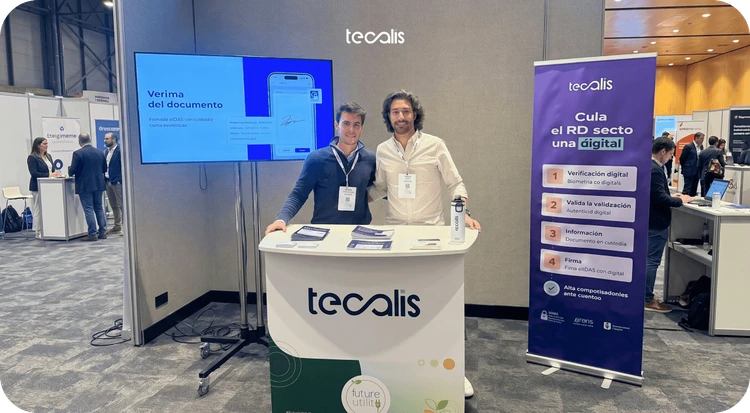
Tecalis was present at Future Utility 2026 with its own booth, staffed by Javier Novoa, Head of Sales, and Carlos Santos, Business Development. There, we demonstrated a complete digital onboarding workflow: identity verification using biometrics and NFC scanning of an ID card or digital wallet, and an eIDAS-compliant electronic signature with evidence retention. This demonstration generated a great deal of interest among energy retailers and explains much of the insights we’ll share below.
The process we presented was structured in four steps (verify, validate, inform, and sign), designed to complete a sign-up in a single workflow, without the customer having to switch channels. At the booth, we also highlighted the guarantees that underpin the proposal: Tecalis is a Qualified Trust Service Provider (QTSP) with a timestamp service and holds High-level ENS certification—two key credentials for companies that manage essential services.
The Tecalis Team’s Takeaways from Future Utility 2026
Beyond the program, Javier Novoa and Carlos Santos spent the entire day talking with professionals from energy retailers and other companies in the sector. From those conversations, they took away five insights that reflect the true pulse of the utilities industry:
- The new regulations are already on the agenda. Under Royal Decree 88/2026, energy retailers are required to adapt their processes, and industry professionals are fully aware of this. It is not a future issue—it is a current priority.
- Friction is just as much a concern as compliance. There is a clear concern about not increasing friction for the customer when implementing technology. Security and compliance must be virtually invisible to the customer.
- Having a dedicated technology partner makes all the difference. Energy retailers value the importance of having a specialized partner to guide them through this and future regulatory changes, rather than having to tackle each new regulation from scratch.
- Fraud must be combated, even if it costs customers. Industry professionals are well aware that fraud has been a recurring issue in the utilities sector and that they must support any measure that eliminates it, even if that sometimes means losing a contract.
- AI is costly, but it’s inevitable. It continues to face some resistance in the sector, but there is a consensus that it is an inevitable change to which they will have to adapt.
What Energy Retailers Should Prioritize in 2027
With Royal Decree 88/2026 now in effect, energy retailers are facing 2027 with a demanding agenda, and recent data show why it’s wise to plan ahead. In February 2026, the CNMC reported that a single retailer, with barely 1% market share, accounted for 61% of complaints regarding deceptive business practices—a reflection of how a weak contract process translates into regulatory and reputational risk. And the threat is evolving: according to the Entrust 2026 Identity Fraud Report, deepfakes are behind one in five biometric fraud attempts, and injection attacks grew by 40% year-over-year.
Given this scenario, these are the four priorities for energy retailers in 2027:
- Verifiable, frictionless identification: Biometrics and NFC scanning of national ID cards make it possible to verify the identity of the person signing up in seconds, comply with the identification requirements of Royal Decree 88/2026, and curb identity theft without hindering conversion rates.
- Evidence and legal certainty: Every registration, consent, and communication requires an electronic signature and traceability to guarantee its evidentiary validity in the event of any claim or inspection.
- Regulatory foresight with a specialized partner: With eIDAS 2 and the EUDI Wallet on the horizon, it’s advisable to have a technology partner that evolves in step with regulations rather than reacting to each new development.
- AI with human oversight: Begin implementing automation and chatbots in registration and customer service processes, measuring ROI while always maintaining human oversight.
The key takeaway from Future Utility 2026 is that the future depends on connecting AI, data, and customers based on digital trust. To achieve this, energy retailers need a technology partner capable of integrating identity verification and electronic signatures into a single automated workflow that is fully eIDAS-compliant. At Tecalis, we want to be that partner.
Finally, we’d like to thank iKN Spain for organizing the event, the sponsors for their involvement, the speakers and moderators for sharing their perspectives, and all attendees for their participation: thanks to them, Future Utility was a hub for conversations, learning, and connections.
Frequently Asked Questions (FAQs)
- What were the main themes of the Future Utility 2026 event? Five: from experimentation to the real-world application of AI; reliable data as the foundation of digital transformation; a customer who is a game-changer; cybersecurity and resilience as strategic priorities; and people equipped to leverage technology.
- What is Royal Decree 88/2026? It is the General Regulation on the Supply, Marketing, and Aggregation of Electricity, approved on February 11, 2026. It reinforces contract guarantees and the obligations of electricity retailers, including the verification of consumer identity.
- What should electricity retailers prioritize in 2027? Verifiably and seamlessly identify the account holder, maintain records of each registration, consent, and communication, strengthen protection against fraud, and apply AI with human supervision—all in accordance with Royal Decree 88/2026.
- How does Tecalis help energy retailers? Through identity verification (KYC and biometrics), electronic signatures with evidence, and certified communications—all integrable via API and compliant with eIDAS—to facilitate quick, secure, and legally valid contracts.
Simplify your energy retailer’s contract processes
Discover the solution for Energy & Utilities