










Index
- What Is Car Rental Software?
- Key Types of Software for Your Mobility Business
- How to Evaluate and Choose the Best Software to Use
- Identification and Digital Signature: The Layer That Completes Rental Management
- Regulatory Compliance and Traceability in Car Rental
- Complete Your Software Infrastructure by Integrating Tecalis

The best content in your inbox
Car rental software is no longer a single program that does it all. Car rental companies that are truly growing—from local agencies to regional networks with dozens of branches—combine a reservation system, a fleet management tool, identity verification, and electronic signatures so that every rental is finalized in minutes, paperlessly and risk-free.
Making the wrong choice comes at a direct cost: lines at the counter, idle cars, contracts that don’t hold up in a dispute, and drivers whose documentation wasn’t properly verified. In this article, we explain what types of software you need, how to evaluate a provider before signing a contract, and which identity and signature layer ties the whole system together.
Discover what the car rental office of the future will look like—open 24/7
Download free brochureWhat Is Car Rental Software?
Car rental software is a set of connected tools that enables a car rental company to manage reservations, fleet availability, contracts, payments, vehicle pick-up and drop-off, and customer verification. Today, it’s not a closed system but a modular ecosystem that integrates via APIs.
A few years ago, software for a car rental company was purchased as a monolithic suite: a single provider, a single system, and a long list of features that were only partially utilized. Today’s prevailing model is different: an operational management core (fleet, rates, billing) surrounded by specialized modules that communicate with one another. Each component perfectly fulfills a specific function for car rental companies and shares data with the others, so that customers don’t have to repeat information and your team avoids duplicate data entry. A well-designed modular architecture typically includes:
- Fleet management software: manages vehicle inventory, condition, maintenance, technical inspections, insurance, mileage, and profitability per vehicle. It’s the operational foundation for everything else.
- Car rental reservation system: the customer-facing module that displays real-time availability, calculates rates, and processes payments for reservations via the website or app.
- Digital identity verification: verifies that the ID and driver’s license are authentic and that the renter is who they claim to be.
- Electronic signature: formalizes the legally binding rental agreement and provides evidence that remains valid for years to come.
- Interactive kiosks and key pickup: allow customers to pick up and return the vehicle without waiting for an agent, even outside of business hours.
- CRM, sales, and payments: These systems centralize customer information, reservations, and history, and link them to billing.
The market is on the side of those who embrace digitalization. According to the IMARC Group, the global car rental market reached $86.1 billion in 2025 and is projected to reach $107.2 billion by 2034, driven largely by online booking and smartphone penetration.
Key Types of Software for Your Mobility Business
Based on fleet management or vehicle leasing businesses, there are three technological building blocks that every rental company needs to operate smoothly and seamlessly. Here’s a summary before we dive into each one:
| Block | What it addresses |
|---|---|
| Digital Identity and Electronic Signature | Verifies the driver and formalizes a legally binding contract. |
| Car Rental Reservation System | Generates sales, processes reservations, and displays real-time availability. |
| Interactive kiosks and key pickup | Automate vehicle pickup and return vehicle. |
Digital Identity and Electronic Signature Software
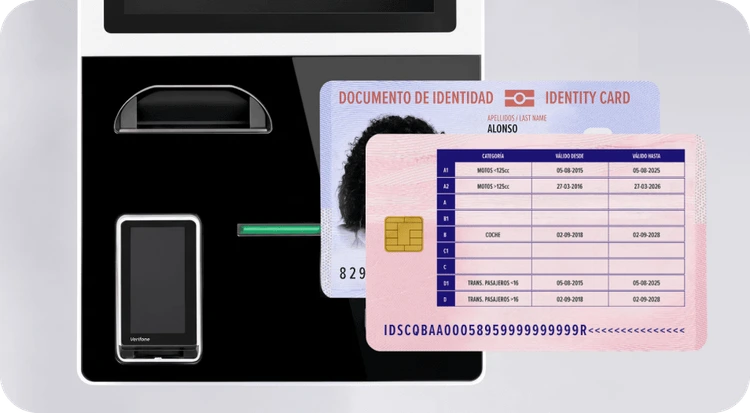
This is the primary security barrier for your business. Its purpose is twofold: to validate the authenticity of the customer’s ID and driver’s license, and to formalize the rental agreement with full legal safeguards. Without this layer, your system only manages reservations but does not verify who is actually taking the vehicle.
The process is very streamlined: the customer takes a photo of their documents with their cell phone, artificial intelligence screens out potential forgeries, and a biometric liveness check confirms that the person in front of the camera is the actual owner. All of this takes just a few seconds and can be done remotely before picking up the car, avoiding long waits at the counter.
Finally, the electronic signature completes the process. The customer receives the contract on their own device and signs it using a one-time password (OTP) or a biometric signature. The entire process generates an audit trail with the date, time, and digital evidence, ensuring that the contract is legally irrefutable in the event of claims regarding fines, damage, or accidents.
The Car Rental Reservation System
This is the module installed on your website that has the greatest impact on revenue, because it’s where sales are generated. A good car rental reservation system should offer, at a minimum:
- Real-time vehicle availability, synchronized with the fleet.
- Online payment for the reservation or deposit, with various payment methods.
- Dynamic rates, extras (child seat, additional driver, GPS), and cancellation policies.
- Fast mobile version, because most reservations start on a phone.
But a standalone booking engine isn’t enough. It needs to integrate with your customer management software (CRM) and with identity verification and signature tools. The goal is to create a seamless flow: the customer books, verifies their identity, and signs without interruption. If these systems don’t communicate, your team ends up entering data manually, and the customer has to repeat unnecessary steps.
Interactive Kiosks and Key Pickup
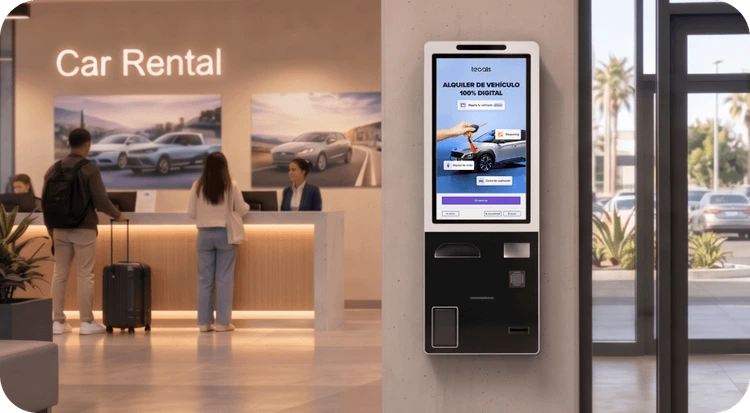
Although they are physical devices, their true intelligence lies in the software inside them. This application connects in real time with your booking system and fleet management to know exactly which car corresponds to each customer and what condition it’s in.
The key to interactive kiosks is that they don’t operate in isolation. They come standard with biometric identity verification, electronic signatures, and deposit collection, automatically replicating everything an agent would do at the counter. When combined with smart key lockers, the process is 100% autonomous: the customer arrives, identifies themselves, signs, and picks up the keys without waiting. When returning the vehicle, the cycle is reversed just as easily.
For a rental company, this means being able to serve customers outside of business hours, handle spikes in demand without expanding the workforce, and free up staff for more profitable tasks, such as selling insurance or add-ons. Additionally, each transaction instantly updates fleet availability and archives the contract—with full legal validity—in your central system.
Learn how Bip & Drive verifies its drivers in three countries
Download the success storyHow to Evaluate and Choose the Best Software to Use
With so many options on the market, comparing individual features can be misleading: almost all programs promise bookings, contracts, and fleet management. What sets a good provider apart from a problematic one is how it integrates, how it protects data, and how much it costs to scale with it. Before signing a contract, it’s wise to review these criteria, listed in order of greatest to least impact on day-to-day operations:
- Cloud architecture (SaaS): eliminates the need for on-premises servers, ensures automatic updates, and allows access from any branch or device.
- Open and documented APIs: This is essential for connecting your fleet management software with booking, identity, e-signature, accounting, or telemetry systems without custom development.
- Scalability: It must support more vehicles, more branches, and seasonal peaks without switching platforms.
- Security and data protection: encryption, access control, auditing, and verifiable regulatory compliance.
- Ease of use: If front-desk staff need weeks of training, the system is already a problem.
- Support and track record: support in your language and time zone, and real-world experience in the mobility sector.
- Transparent pricing model: ideally pay-as-you-go or per module, with no hidden implementation costs.
Here are the questions you should ask any provider during the demo phase:
| What to Look For | Why it matters |
|---|---|
| SaaS deployment in the cloud | Less maintenance and continuous updates. |
| REST APIs and webhooks | Quick integration with other applications. |
| Native integration with identity and signature | Seamless workflow without re-entering data. |
| Certifications and compliance | Reduces legal and reputational risk. |
| Trial or pilot program | Validate the fit before committing. |
The rule of thumb is simple: prioritize integration over the number of features. A system with fewer buttons but connected to the rest of your operation performs better than a very comprehensive one that operates in isolation.
Practical tip: Ask the provider to walk you through the entire workflow using a real-world scenario—from the online reservation and driver verification to signing the contract and vehicle handoff. If at any point you have to switch screens, manually copy data, or go through another system, that’s where you’ll lose time every day.
Identification and Digital Signature: The Layer That Completes Rental Management
Your fleet management software knows which vehicles you have, and your reservation system knows who wants to rent them. What’s missing to close the loop is verifying the driver’s identity and creating a contract that’s indisputable. That’s the identity and digital signature layer.
Document verification and biometrics during driver onboarding
Onboarding a driver is the moment of greatest risk and friction. If done incorrectly, cars are rented to people with fake documents or drivers without a valid license; if done too slowly, the customer gets frustrated and goes to the competition. Digital verification solves both problems at once:
- Document scanning and validation: the technology extracts data from the ID and driver’s license and detects forgeries, photocopies, and tampering.
- Liveness check and facial recognition: verifies that the face in the selfie matches the photo on the document and that the person is physically present at that moment—not a photograph or a video.
- Validity check: This verifies that the license is valid and corresponds to the category of the vehicle being rented.
The result is a process that takes just seconds, can be completed from home before arriving at the branch, and drastically reduces the risk of rental fraud. Furthermore, it transforms a procedure that previously required photocopies and manual review into a digital onboarding process that is convenient for the customer and auditable for the company.
The Crucial Role of the Signature in Your Software Tools
A signature isn’t just valuable at the moment it’s affixed; it’s also valuable for the evidentiary security it can provide years later in the event of any dispute. When you transfer such a high-value asset to a third party, you need absolute certainty that every clause and liability is fully protected. That’s the key benefit of the electronic signature in car rentals.
Imagine that months later, a traffic ticket, an unpaid toll, or an accident involving the car arises. If the contract does not clearly identify who signed it, or if it cannot be proven when and how it was signed, the company bears a cost that should fall on the driver.
That’s why you need a signature that’s admissible in court: with proof of identity, a timestamp, full traceability, and secure document storage. In the European ecosystem, these guarantees are provided by Qualified Trust Service Providers (QTSPs). With a properly implemented electronic signature, the contract becomes solid evidence—not a piece of paper open to dispute.
A real-life example: A customer returns the vehicle with damage they claim not to have caused, and months later, a traffic ticket appears in their name. If the contract was signed with prior identity verification, a timestamp, and archived evidence, the company can prove who was driving, under what conditions, and in what condition the vehicle was returned. Without that traceability, the company is left to negotiate without evidence.
Regulatory Compliance and Traceability in Car Rental
Any software you contract will process sensitive personal data from your drivers: ID images, biometric data, driver’s licenses, payment methods, and, often, vehicle location. Therefore, regulatory compliance is not an afterthought but an essential purchasing criterion. The software must comply with the strictest privacy laws and the highest international standards so that electronic identification and signatures have the level of assurance and legal validity required by a contract. In the European Union, this means complying with the GDPR for personal and biometric data and the eIDAS Regulation for electronic identification and signatures, in addition to holding recognized security certifications such as ISO 27001 or, in Spain, the National Security Scheme (ENS). If you do business with tourists or foreign customers, having a technology solution designed to comply with global regulations from the very beginning is vital.
Traceability is the other half of the equation. Every action (verification, signature, delivery, return) must be logged with the date, time, and person responsible, and must be retrievable when needed. This means choosing providers that implement encryption, data minimization, and clear retention policies—and that can prove it with documentation and certifications.
In practice, a compliant provider saves you from fines, claims, and reputational damage. We recommend always requesting their privacy policy, data processing agreement, and contractual data custody guarantees before signing a contract.
Complete Your Software Infrastructure by Integrating Tecalis
If you already have a fleet and reservation management system, you don’t have to change it to achieve 100% digital rentals. Tecalis provides the missing layer and connects directly via API to your company’s management software, so that identity data and signed contracts are transferred to your system without manual intervention. These are modular solutions that can be activated according to your needs:
- Customer verification: Tecalis Identity. Verifies ID and driver’s licenses using AI and facial biometrics in seconds, either remotely or at the pickup location.
- Instantly Signed Contracts: Tecalis Sign. Finalize the lease agreement with full legal guarantees, from any device, with evidence and secure storage.
- Unified business management: Tecalis Customer Hub. Combines sales, identity verification, and signing into a single omnichannel workflow, with the customer at the center.
- In-Branch Self-Service: Tecalis Kiosks. These bring identification, signing, and key pickup to an unattended physical location connected to your network.
The result is a fully automated and legally compliant car rental process: the customer books from their phone, verifies their identity in seconds, signs a paperless contract, and picks up the car without waiting in line. Your team saves time, your fleet turns over faster, and every contract is fully documented.
Frequently Asked Questions (FAQs)
- What is car rental software? It’s a suite of connected tools that allows a car rental company to manage reservations, its fleet, contracts, payments, vehicle pickups and returns, and driver verification all within a single digital workflow.
- What software does a car rental company need? At a minimum, fleet management software, a car rental reservation system, digital identity verification, electronic signatures, and—if operating out of branches—kiosks for key pickup. The key is that all these components integrate with one another.
- What’s the difference between fleet management software and a reservation system? Fleet management software controls the inventory, maintenance, and profitability of each vehicle. The reservation system is the customer-facing module that displays availability, processes payments, and captures sales. They must share data in real time.
- How do you choose the best car rental software? Prioritize solutions that are cloud-based (SaaS), offer open APIs to connect with other applications, scale with your business, and comply with data protection regulations (GDPR) and trust services regulations (eIDAS).
- Is an electronic signature valid on a car rental contract? Yes, provided it is implemented with guarantees of identification, a timestamp, traceability, and secure storage. An advanced electronic signature, backed by a trusted service provider, provides evidence that holds up in court if a fine or an accident arises years later.
- Can I digitize my rental business without changing my current software? Yes. If your fleet and reservation software offers an API, you can add modules for identity verification, electronic signatures, and kiosks without switching systems.
Let’s talk about how to digitize your car rental business!
Contact our mobility experts